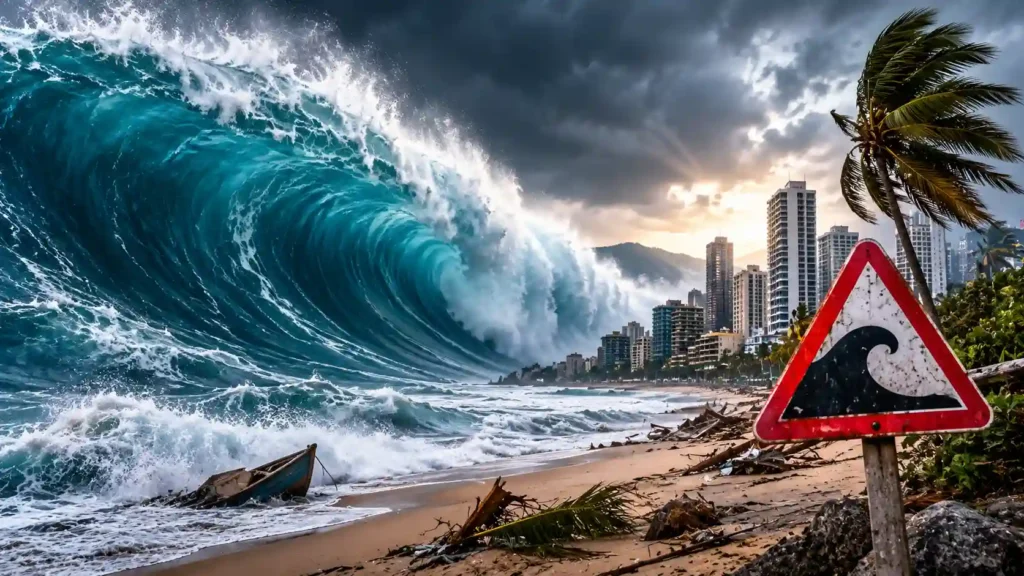
A tsunami is one of the most powerful natural disasters, capable of sending enormous waves across oceans and flooding coastal communities within minutes. Unlike normal ocean waves, a tsunami is usually caused by underwater earthquakes, volcanic eruptions or landslides that suddenly displace large amounts of water.
Interest in tsunamis has increased following major earthquake events, tsunami warnings in Hawaii, and new international preparedness initiatives. Events such as the 2025 Kamchatka earthquake and the June 2026 Mindanao earthquake have demonstrated how quickly tsunami threats can develop and affect coastal regions thousands of miles away.
Understanding what a tsunami is, why it happens and how to recognize its warning signs is essential for people living near the ocean. This guide explains tsunami formation, recent developments, historical disasters, Pakistan’s tsunami risk and important safety measures.
What Is a Tsunami?
A tsunami is a series of powerful ocean waves created by the sudden movement of a large volume of water. Most tsunamis are triggered by underwater earthquakes that cause the ocean floor to rise or fall.
When this happens, the displaced water creates waves that spread outward in different directions. These waves can travel across entire oceans before reaching distant coastlines.
Unlike ordinary wind-driven waves, tsunamis move through the full depth of the ocean. In deep water, they may have relatively small heights and remain difficult to notice. However, when they approach shallow coastal areas, their speed decreases, and the water can build up, producing dangerous flooding and strong currents.
A tsunami is not a single giant wave. It usually consists of multiple waves that may arrive over several hours. The first wave is not necessarily the largest or most destructive.
Tsunamis are sometimes called tidal waves, but this term is misleading because they are not caused by normal ocean tides.
ARTICAL: https://indianstimes.com/rhabdomyolysis/
Why Do Tsunamis Happen?
Tsunamis happen when an underwater disturbance suddenly displaces a significant amount of water. Although earthquakes are responsible for most tsunami events, several other natural processes can also generate these waves.
Underwater Earthquakes
Underwater earthquakes are the leading cause of tsunamis. They occur when tectonic plates suddenly move along faults beneath the ocean.
If an earthquake causes the seafloor to rise or sink, it pushes the water above it and generates waves. Large earthquakes near subduction zones are particularly capable of producing destructive tsunamis.
However, not every underwater earthquake creates a tsunami. The amount of vertical movement, earthquake depth, and size of the affected seafloor all influence the potential threat.
Underwater Landslides
Underwater landslides happen when large amounts of rocks, sediment or other materials suddenly move down the ocean floor.
This movement displaces surrounding water and can create powerful waves. Landslides falling from coastal cliffs into the ocean can also generate local tsunamis.
Volcanic Eruptions
Volcanic activity can produce tsunamis through underwater explosions, collapsing volcanic structures, and large landslides.
The 2022 Hunga Tonga-Hunga Ha’apai volcanic eruption demonstrated how powerful volcanic activity can generate tsunami waves across distant regions.
Meteorite Impacts
A large asteroid or meteorite striking the ocean could displace enormous quantities of water and potentially generate tsunami waves. However, this is an extremely rare cause.
What Does a Tsunami Look Like?
A tsunami does not always look like the giant curling wave shown in movies. Its appearance depends on ocean depth, coastal geography, and the strength of the event.
In deep ocean water, tsunami waves may be relatively small and difficult to notice. As they approach land, they can appear as:
- A rapidly rising wall of water.
- A powerful flood moving toward the coastline.
- An unusually strong ocean current.
- A sudden withdrawal of seawater from the beach.
- Multiple waves repeatedly flooding and retreating from coastal areas.
Some tsunamis can reach extreme heights, while others cause dangerous flooding without appearing particularly dramatic.
Their destructive power comes from the enormous volume of moving water, which can carry vehicles, boats, trees and heavy debris into populated areas.
Where Do Tsunamis Happen?
Tsunamis can occur along coastlines around the world, but some regions face greater risks because they are located near active tectonic plate boundaries.
The Pacific Ring of Fire is particularly vulnerable because it contains numerous earthquake-generating faults.
Some tsunami-prone countries and regions include:
- Japan: Its location near several active tectonic plate boundaries makes it vulnerable to powerful earthquakes and tsunamis.
- Indonesia: The country experiences significant earthquake activity along the Indian and Pacific Ocean tectonic regions.
- Chile: Earthquakes along the western coast of South America can generate tsunamis across the Pacific.
- Alaska: Strong earthquakes in the region can produce dangerous waves.
- New Zealand: Its location near active plate boundaries creates tsunami risks.
- Philippines: Its position in a seismically active region exposes coastal communities to earthquake-related tsunami hazards.
Although the Pacific Ocean experiences many tsunamis, the Indian Ocean, Atlantic Ocean, and Mediterranean Sea can also experience these events.
Latest Tsunami News and Important Developments in 2026
Tsunami preparedness and early-warning technology remain important international priorities in 2026. Recent earthquakes and upcoming awareness campaigns have highlighted the importance of monitoring systems and public education.
World Tsunami Awareness Day 2026
World Tsunami Awareness Day takes place on November 5 every year. The 2026 theme is “Be Tsunami Ready: Resilience Starts With You.”
The campaign focuses on individual and community preparedness. It encourages people to recognize natural warning signs, understand evacuation routes, and prepare household emergency plans.
It also highlights the importance of supporting children, older adults, people with disabilities and tourists during coastal emergencies.
NEAMWave26 International Tsunami Exercise
NEAMWave26 is an international tsunami preparedness exercise scheduled from November 5 to November 19, 2026.
Coordinated by UNESCO’s Intergovernmental Oceanographic Commission, the exercise brings together scientific organizations, national authorities and emergency response agencies.
Its purpose is to test tsunami warning procedures across the northeastern Atlantic, Mediterranean and connected seas.
The exercise uses simulated scenarios rather than real tsunami events. It helps participating countries identify communication problems, improve evacuation procedures and strengthen emergency coordination.
June 2026 Mindanao Earthquake and Tsunami Warning
On June 7, 2026, a magnitude 7.8 earthquake struck offshore Mindanao in the southern Philippines.
The Pacific Tsunami Warning Center issued its first threat message approximately six minutes after the earthquake. Authorities warned several coastal regions about possible dangerous waves.
Tsunami activity was subsequently measured at monitoring stations in the Philippines. The highest preliminary wave height reported at Kiamba, Sarangani, was 1.48 meters.
After monitoring the situation and observing that the threat had decreased, Philippine authorities cancelled the tsunami warning on June 8.
The event demonstrated how quickly international monitoring networks can respond to major earthquakes.
July 2025 Kamchatka Earthquake and Pacific Tsunami
On July 29, 2025, a magnitude 8.8 earthquake struck offshore Russia’s Kamchatka Peninsula.
The earthquake generated tsunami waves that traveled across the Pacific Ocean and triggered warnings and evacuations in several regions.
Hawaii was among the affected areas. Monitoring stations recorded tsunami activity, including a wave amplitude of approximately 1.74 meters at Kahului, Maui.
The tsunami advisory for Hawaii was cancelled on July 30 after the waves decreased below advisory levels. However, authorities continued advising caution because unusual currents could persist.
This event showed how an earthquake thousands of miles away can create a tsunami threat for distant coastal communities.
Did the Tsunami Hit Hawaii?
Yes. Hawaii experienced tsunami waves following the powerful Kamchatka earthquake on July 29, 2025.
The Pacific Tsunami Warning Center issued a tsunami warning for Hawaii after confirming that the earthquake had generated waves capable of affecting Pacific coastlines.
Residents and visitors were advised to leave vulnerable coastal areas and follow evacuation instructions.
Tsunami monitoring stations recorded wave activity across the Hawaiian Islands. Kahului, Maui, recorded an amplitude of approximately 1.74 meters, while other locations experienced different levels of activity.
The advisory was cancelled the following morning when measurements showed that wave heights had decreased below advisory levels.
This event explains why searches about whether a tsunami hit Hawaii became relevant. It also demonstrates that tsunamis can travel across the Pacific even when their original earthquake occurs near Russia.
Can a Tsunami Happen in Pakistan?
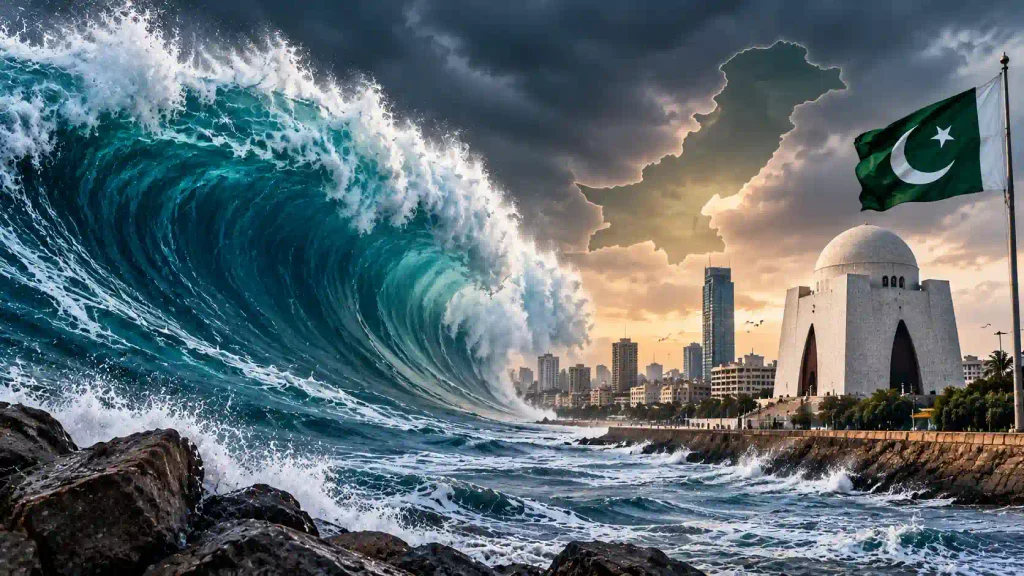
Yes. Pakistan has a tsunami risk because its coastline is located along the Arabian Sea, near the Makran Subduction Zone.
This geological region is where the Arabian Plate moves beneath the Eurasian Plate. Large underwater earthquakes in this area can displace the ocean floor and potentially generate tsunami waves.
The 1945 Makran Tsunami
One of the most important tsunami disasters in Pakistan’s history occurred on November 28, 1945.
A powerful earthquake struck near the Makran Coast of Balochistan and generated tsunami waves in the Arabian Sea.
The disaster caused severe destruction along coastal communities, including areas near Pasni and Ormara. Historical records and Pakistani disaster-management documents report thousands of deaths associated with the event.
Which Areas of Pakistan Face Tsunami Risk?
Pakistan’s National Disaster Management Authority identifies several coastal districts as potentially vulnerable to tsunami hazards.
These include:
- Gwadar
- Lasbela
- Karachi
- Thatta
- Sujawal
The level of risk varies according to earthquake location, seafloor movement, and coastal geography.
People living in vulnerable coastal areas should understand local evacuation routes and follow official emergency instructions.
What Are the Warning Signs of a Tsunami?
Recognizing natural warning signs can help people move to safety before a tsunami reaches the coastline.
Important signs include:
Strong or prolonged earthquakes: Significant ground shaking near the coast can indicate a potential tsunami threat.
Sudden ocean withdrawal: Seawater may rapidly move away from the beach, exposing rocks, reefs and parts of the ocean floor.
Unusual sea-level movement: A sudden rise or fall in water levels can indicate an approaching tsunami.
Loud roaring sounds: Some people report hearing a powerful sound from the ocean before waves arrive.
Official emergency alerts: Government warnings and evacuation instructions should always be taken seriously.
Do not wait for every warning sign to appear. If you experience strong earthquake shaking near the coast, move to higher ground as soon as it is safe.
How Fast Can a Tsunami Travel?
A tsunami can travel at speeds exceeding 500 miles per hour in deep ocean water, depending on the depth of the sea.
As the waves approach shallow coastal areas, their speed decreases. However, the water can build up, creating stronger currents and dangerous flooding.
The time required to reach land depends on the distance between the earthquake or other triggering event and the affected coastline.
A locally generated tsunami may arrive within minutes, while a distant tsunami may take several hours to cross an ocean.
This is why early-warning systems and evacuation plans are essential for coastal communities.
What Damage Can a Tsunami Cause?
Tsunamis can have serious consequences for people, infrastructure, businesses and the natural environment.
Loss of Human Life
Powerful waves can cause drowning, serious injuries and widespread displacement. Communities may have very little time to evacuate when a tsunami develops close to shore.
Destruction of Buildings and Infrastructure
Flooding can damage homes, hospitals, schools, roads, bridges, ports and electricity networks.
Environmental Damage
Tsunamis can cause coastal erosion, destroy vegetation, damage marine habitats and contaminate freshwater supplies.
Economic Losses
Fishing, tourism, transportation and local businesses can suffer significant financial losses.
Long-Term Community Effects
Survivors may experience housing shortages, disrupted education, healthcare problems and lengthy recovery periods.
Dangerous currents can continue after the first wave passes, so affected communities must wait for official confirmation before returning to coastal areas.
How Do Scientists Detect and Monitor Tsunamis?
Scientists use several technologies to identify potential tsunami threats and estimate their effects.
Seismic monitoring stations: These detect earthquakes and measure their location, magnitude, and depth.
DART ocean buoys: Deep-ocean instruments detect changes in water pressure and help identify tsunami waves.
Coastal tide gauges: These measure sea-level changes near shorelines.
Computer forecasting models: These help estimate wave arrival times, possible heights, and potential coastal flooding.
Warning centers analyze this information and communicate alerts to emergency authorities.
Although scientists cannot predict exactly when and where the next tsunami will happen, modern monitoring systems can provide important information after a potentially dangerous event.
How Can You Stay Safe During a Tsunami?
Preparation and quick action can save lives during a tsunami emergency.
Before a Tsunami
- Learn whether your home or workplace is located in a tsunami hazard zone.
- Identify nearby high ground and evacuation routes.
- Prepare an emergency kit containing water, food, medicines, and essential documents.
- Discuss evacuation plans with family members.
- Follow official emergency alerts and weather updates.
During a Tsunami
- Move immediately to higher ground or travel inland.
- Follow evacuation instructions from emergency authorities.
- Stay away from beaches, harbors, rivers, and coastal waterways.
- Never approach the shoreline to watch or photograph the waves.
- If reaching high ground is impossible, follow local guidance about vertical evacuation in a suitable sturdy building.
After a Tsunami
- Stay in a safe location until authorities announce that the danger has passed.
- Avoid flooded roads and damaged buildings.
- Stay away from fallen electrical wires.
- Do not walk or drive through floodwater.
- Return home only when authorities confirm it is safe.
Remember that the first tsunami wave may not be the largest or most dangerous.
What Was the 2004 Indian Ocean Tsunami?
The December 26, 2004, Indian Ocean tsunami was one of the deadliest natural disasters in modern history.
A massive undersea earthquake occurred near northern Sumatra, Indonesia, displacing an enormous volume of ocean water.
The resulting waves traveled across the Indian Ocean and affected coastal communities in 17 countries, including Indonesia, Thailand, Sri Lanka and India.
More than 200,000 people lost their lives, while millions experienced displacement and destruction.
The disaster exposed major weaknesses in regional tsunami preparedness and highlighted the need for international warning networks.
It also became a turning point in the development of tsunami monitoring, emergency communication and early-warning systems across the Indian Ocean.
Conclusion
A tsunami is a powerful natural disaster that can affect coastal communities across the world. Most tsunamis develop after underwater earthquakes, but volcanic eruptions and landslides can also generate dangerous waves.
Recent events, including the Kamchatka earthquake, the Mindanao tsunami warning and the upcoming World Tsunami Awareness Day 2026, highlight why tsunami awareness and preparedness remain important.
For countries such as Pakistan, understanding the risks associated with the Makran Subduction Zone is particularly important.
Although tsunamis cannot be prevented, scientific monitoring, early-warning systems and well-planned evacuations can reduce their impact. Recognizing natural warning signs and moving to higher ground immediately can help save lives.
Frequently Asked Questions About Tsunamis
What Is a Tsunami?
A tsunami is a series of powerful ocean waves created by the sudden displacement of water. Underwater earthquakes are the most common cause, but volcanic eruptions and landslides can also generate these waves.
What’s a Tsunami and How Is It Different From a Normal Wave?
A tsunami involves the movement of enormous amounts of water throughout the ocean’s depth. Normal waves are mainly driven by wind and usually affect the ocean’s surface. This difference makes tsunamis much more powerful and potentially destructive.
Did the Tsunami Hit Hawaii?
Yes. Tsunami waves reached Hawaii after the magnitude 8.8 Kamchatka earthquake on July 29, 2025. Authorities issued warnings and evacuation instructions, and monitoring stations recorded significant wave activity around the islands.
Did a Tsunami Hit Hawaii After the Russia Earthquake?
Yes. The July 2025 earthquake near Russia’s Kamchatka Peninsula generated tsunami waves that traveled across the Pacific Ocean. Hawaii experienced measurable wave activity, and its tsunami advisory was cancelled on July 30 after conditions improved.
Did Tsunami Hit Hawaii in 2026?
The major Hawaii tsunami event discussed in recent searches was associated with the July 2025 Kamchatka earthquake. The June 2026 Mindanao earthquake generated a separate tsunami warning for parts of the Philippines. These events should not be confused when checking historical tsunami reports.
Can a Tsunami Happen Without an Earthquake?
Yes. Underwater landslides, volcanic eruptions, and large rock collapses can suddenly displace water and generate tsunami waves without an earthquake.
Is Pakistan at Risk of a Tsunami?
Yes. Pakistan’s Makran Coast faces tsunami hazards associated with the Makran Subduction Zone in the Arabian Sea. The 1945 Makran earthquake generated a destructive tsunami that affected coastal communities.
How Long Can Tsunami Waves Continue?
A tsunami can produce multiple waves over several hours. Dangerous currents and flooding may continue long after the first wave arrives, which is why people should wait for official safety instructions before returning to the coast.
SOURCE: Wikipedia