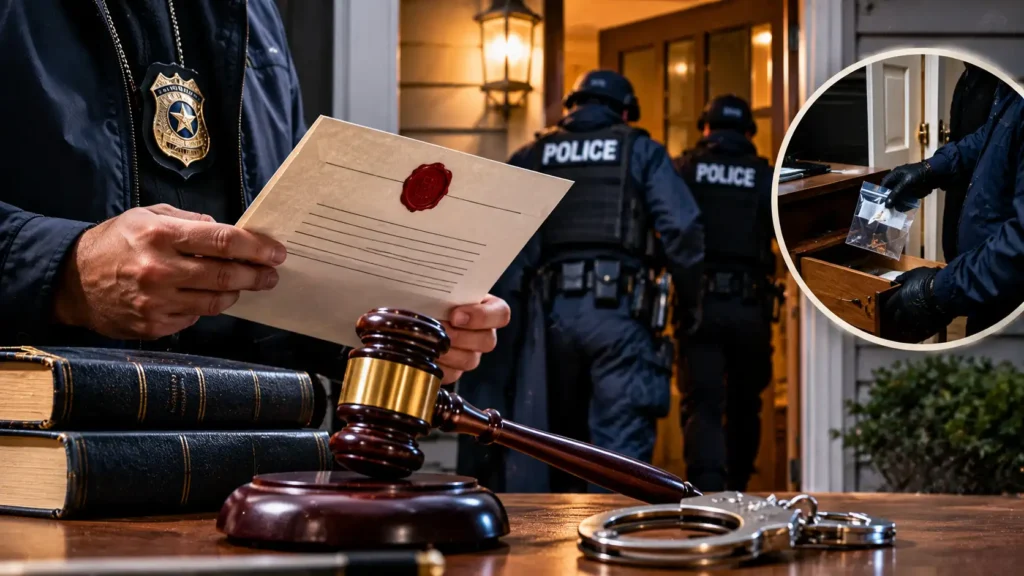
A search warrant is an important legal document that gives law enforcement officers permission to search a specific property, location, or electronic device for evidence connected to a suspected crime. In the United States, search warrants play a major role in criminal investigations while helping protect individuals from unreasonable government searches.
Police may request a search warrant when they believe evidence of illegal activity is located inside a home, vehicle, business, or another property. However, officers must follow constitutional requirements and stay within the authority granted by the warrant. In most situations involving a private home, they need approval from a judge before conducting an evidence-gathering search.
The Fourth Amendment protects people against unreasonable searches and seizures. It also establishes requirements involving probable cause, sworn information, and a specific description of the location and property covered by a warrant.
Understanding how a search warrant works is useful for anyone interested in police investigations, criminal law, personal privacy, and legal rights. This guide explains the search warrant definition, how officers obtain judicial approval, when police can search without a warrant, and what happens when authorities collect evidence.
What Is a Search Warrant?
A search warrant is a legal authorization issued by an authorized judge or magistrate that allows law enforcement officers to examine a specified location or property for evidence connected to a suspected offense.
Before requesting a warrant, investigators generally need to establish probable cause. They must present facts supporting a reasonable belief that evidence, illegal property, or other legally seizable items will be found at the proposed search location.
For example, suppose police are investigating a burglary and receive reliable information that stolen jewelry is being kept inside a particular house. Investigators can present their findings to a judge and request permission to search that property.
If the judge approves the application, the warrant identifies the location officers can search and the items they are authorized to seize.
A search warrant does not automatically mean the property owner has committed a crime. Someone’s home or business may be connected to an investigation even when that person is not the primary suspect.
The main purpose is to give law enforcement a lawful way to collect evidence while respecting constitutional privacy protections.
ARTICAL: Dave Chappelle: Biography, Comedy Career, Shows and Latest News (2026)
Search Warrant Definition and Meaning
The search warrant definition refers to a judicial document that authorizes police or other law enforcement officials to search a particular place or property for evidence related to an investigation.
The term has two basic components:
- Search: Examining a location, person, vehicle, or property to find information or evidence.
- Warrant: Official legal permission issued by a court or authorized judicial officer.
Together, these words describe a legal process that allows a specific search under established conditions.
The meaning of a search warrant is closely connected to the Fourth Amendment of the US Constitution. This amendment protects people against unreasonable searches and seizures and requires warrants to meet important constitutional standards.
For example, a warrant authorizing officers to search for stolen electronics does not automatically give them permission to investigate every unrelated document or personal item they encounter.
Officers must generally follow the warrant’s scope, including its description of the location and the evidence being sought.
Why Are Search Warrants Important in Criminal Investigations?
Search warrants help balance two important interests: the government’s responsibility to investigate suspected crimes and an individual’s right to privacy.
Without legal safeguards, police searches could become unnecessarily broad or intrusive. Judicial authorization creates an independent review process before many searches of private property take place.
Search warrants serve several purposes:
Protection of privacy: They help prevent unrestricted searches of homes and other protected locations.
Judicial oversight: A judge or magistrate evaluates the information presented by investigators before approving a warrant.
Evidence collection: They provide legal authority to collect relevant documents, objects, electronic information, and other evidence.
Defined search boundaries: The warrant identifies what officers can search and what they may seize.
Legal accountability: The application and warrant create a record that can be examined during later court proceedings.
These protections are especially important in investigations involving sensitive personal information, financial records, private communications, and electronic devices.
How Do Police Obtain a Search Warrant?
Obtaining a search warrant involves more than simply asking a judge for permission. Investigators generally need to prepare supporting information that establishes probable cause.
Although the exact procedure differs between jurisdictions, the process usually follows several stages.
1. Gathering Information and Evidence
Police begin by investigating a suspected crime. They may collect witness statements, photographs, surveillance recordings, financial documents, or other relevant information.
Investigators must develop a factual basis connecting the suspected evidence to the location they want to search.
2. Preparing the Warrant Application
Officers prepare an application explaining the reason for the proposed search.
This commonly includes an affidavit containing sworn information about the investigation, the suspected offense, and the evidence believed to be located at the property.
3. Judicial Review
A judge or authorized magistrate reviews the application and determines whether probable cause exists.
The judicial officer considers the totality of the circumstances rather than simply accepting the investigator’s conclusions.
4. Approval and Issuance
If the application satisfies the legal requirements, the judge may issue the search warrant.
The document identifies the property to be searched and the items or evidence officers are authorized to seize.
5. Execution of the Warrant
Authorized officers conduct the search according to the warrant and applicable law.
They may inspect relevant areas, examine permitted containers, and collect evidence covered by the authorization.
6. Documentation and Evidence Handling
After the search, officers generally prepare the required inventory or receipt for seized property and complete the appropriate court paperwork.
Evidence may then be examined by investigators, forensic specialists, or prosecutors.
Federal Rule of Criminal Procedure 41 explains the procedures for obtaining, issuing, and executing federal search warrants.
What Does Probable Cause Mean?
Probable cause is one of the most important concepts in search warrant law.
It means there must be sufficient facts and circumstances to support a reasonable belief that evidence of a crime or other legally seizable property will be found at a particular location.
For instance, police may receive information from a reliable witness, discover records connecting a property to a suspected offense, or observe activities that support an investigation.
A judge evaluates the available information to determine whether the legal standard is satisfied.
Probable cause is not the same as proof beyond a reasonable doubt. Investigators do not need to establish someone’s guilt before obtaining a search warrant. However, they must provide enough information to justify the proposed search.
It is also important to distinguish probable cause from reasonable suspicion. Reasonable suspicion generally supports certain limited investigative actions, while probable cause is a higher standard used for obtaining search warrants and making arrests.
What Information Must a Search Warrant Include?
A search warrant must identify the search with enough detail to prevent officers from receiving unlimited authority.
Depending on the jurisdiction and type of warrant, it generally includes:
- The issuing court or judicial officer.
- The date the warrant was approved.
- The address or description of the property.
- The person or property authorized to be searched.
- The items or evidence that may be seized.
- The judicial authorization and applicable execution conditions.
The particularity requirement is especially important.
For example, if police receive authorization to search a property for stolen firearms, the warrant should identify the location and describe the items being sought. Officers cannot automatically use it as permission to conduct unrelated searches.
This requirement helps prevent general searches and protects individuals against unnecessary government intrusion.
What Can Police Search With a Warrant?
A search warrant may cover different types of property depending on the investigation and the language of the authorization.
Homes and Apartments
A warrant may allow officers to search a specific house, apartment, room, or other residential location.
The home receives strong constitutional protection, so officers generally need a valid warrant or an applicable exception to enter for an evidence-gathering search.
Cars and Other Vehicles
Police may obtain a warrant to search a particular vehicle for evidence connected to a criminal investigation.
The warrant determines which parts of the vehicle and which items are covered.
Smartphones and Computers
Electronic devices can contain important evidence, including photographs, messages, financial records, and other digital information.
A warrant may authorize the seizure or examination of electronic devices and specified electronically stored information.
Documents and Personal Property
Investigators may search for business records, financial documents, photographs, weapons, stolen property, or other evidence described in the warrant.
The scope of the search depends on the object being sought and the legal authority provided.
Search Warrant vs. Arrest Warrant vs. Bench Warrant
These legal documents are commonly discussed together, but they have different purposes.
Type of warrant: What it authorizes
Search warrant A specific search for evidence or property.
Arrest warrant The arrest of an identified person.
Bench warrant An arrest based on a court’s order, commonly following a failure to appear or comply with a court requirement.
For example, investigators may obtain a search warrant to look for stolen property inside a house. They may separately request an arrest warrant for someone suspected of the burglary.
A bench warrant is different because it is generally connected to a court proceeding rather than an investigation into where physical evidence is located.
Having one type of warrant does not automatically provide all the powers associated with another.
When Can Police Search Without a Warrant?
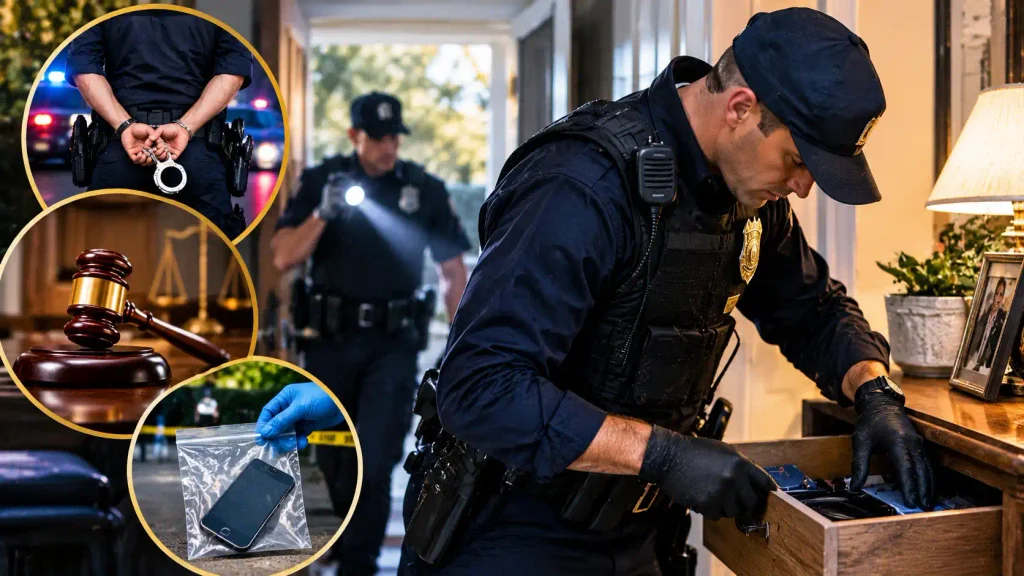
Although search warrants are an important constitutional protection, US law recognizes several exceptions to the general warrant requirement.
These exceptions depend on specific circumstances and do not give police unlimited authority.
Voluntary Consent
Police may conduct a search when someone with appropriate authority voluntarily agrees.
The person providing consent generally determines the scope of the permitted search. Consent obtained through legally improper pressure or threats may be challenged.
Emergency Situations
Exigent circumstances may justify an immediate search or entry when waiting for a warrant would create a serious risk.
Examples include situations involving imminent physical harm, the destruction of evidence, or a suspect’s escape.
Search Connected to a Lawful Arrest
Officers may search certain areas or belongings connected to a lawful arrest under established constitutional rules.
However, this authority has specific limitations and does not automatically permit a complete search of every location or electronic device associated with the arrested person.
Automobile Exception
Police may search a vehicle without first obtaining a warrant when they have probable cause to believe it contains evidence or contraband.
This exception recognizes the mobility of vehicles and has been developed through US Supreme Court decisions.
Plain View
Officers who are lawfully present may sometimes seize evidence they can immediately recognize as contraband or evidence of a crime, provided the legal requirements are satisfied.
The circumstances surrounding the discovery and the officers’ lawful access to the item matter.
How Does a Search Warrant Apply to Digital Devices?
Digital evidence has become an important part of modern criminal investigations.
Smartphones, laptops, tablets, cloud accounts, and storage devices can contain information relevant to suspected offenses.
For example, investigators examining a fraud case may seek access to financial records, communication records, photographs, or files stored on a computer.
Federal Rule of Criminal Procedure 41 allows warrants involving electronically stored information. It also recognizes that investigators may seize or copy storage media and review relevant information later, subject to the warrant and applicable legal requirements.
The distinction between taking possession of a device and examining all the information stored on it is important. A warrant or another valid legal basis may be necessary for the digital search.
In Riley v. California, the US Supreme Court held that police generally must obtain a warrant before searching digital information on a cellphone seized during an arrest, subject to applicable exceptions.
This illustrates how constitutional privacy protections apply to modern technology.
What Is a No-Knock Search Warrant?
A no-knock search warrant refers to a search involving entry without the usual knock-and-announce procedure.
Normally, officers executing a residential search warrant are generally expected to announce their identity, authority, and purpose before entering and provide occupants a reasonable opportunity to respond.
However, courts recognize limited circumstances in which a different approach may be legally justified.
For example, an immediate announcement could create a serious safety risk or allow evidence to be destroyed.
A no-knock entry is not automatically permitted simply because police have a search warrant. Officers must follow applicable constitutional requirements and judicial decisions governing the circumstances.
How Long Is a Search Warrant Valid?
A search warrant usually includes an execution deadline. This determines how long officers have to carry out the authorized search.
Under Federal Rule of Criminal Procedure 41, an ordinary federal warrant to search for and seize a person or property must generally specify an execution period of no more than 14 days.
The federal rule also generally requires execution during daytime hours, defined as 6 a.m. to 10 p.m. local time, unless a judge authorizes another time for good cause.
However, federal rules should not be confused with state and local procedures. Different jurisdictions may have different requirements.
Electronic information warrants can also involve a two-stage process in which officers seize or copy information and conduct an authorized review later.
Therefore, the deadline for executing a warrant and the time required to examine collected evidence are separate issues.
What Happens After Police Complete a Search?
Completing a search does not necessarily end the investigation.
Once officers finish examining the authorized property, several steps may follow.
Property inventory: Officers generally document the items they seize and provide the required receipt or paperwork.
Evidence examination: Investigators may examine physical objects, documents, electronic devices, or other collected material.
Forensic analysis: Specialists may analyze fingerprints, digital records, photographs, or other evidence.
Further investigation: Police may interview witnesses, compare evidence, and investigate additional leads.
Prosecutorial review: If investigators believe there is sufficient evidence, prosecutors may consider whether criminal charges are appropriate.
Finding an item during a search does not automatically establish guilt. The prosecution must still meet the applicable legal standards.
Can a Search Warrant Be Challenged in Court?
Yes. A person affected by a search may challenge the warrant or the way officers conducted the search when legally sufficient grounds exist.
Potential issues include:
- A lack of sufficient probable cause.
- Incorrect or misleading information in the warrant application.
- An improperly described search location.
- Officers exceeding the warrant’s authorized scope.
- Unlawful seizure of property.
- Failure to follow applicable legal procedures.
In some cases, a defense attorney may file a motion to suppress evidence obtained through an unconstitutional search.
However, evidence is not automatically excluded whenever a search is disputed. Courts consider the facts, applicable constitutional rules, and any relevant exceptions.
A qualified criminal defense attorney can review the warrant, supporting affidavit, search procedures, and available legal remedies.
What Should You Do When Police Present a Search Warrant?
A police search can be stressful, particularly when officers arrive unexpectedly at a home or business.
Understanding the basic legal process can help individuals respond without creating additional problems.
Consider these practical steps:
- Request to see the warrant: Ask officers to show you the document and provide a copy when available.
- Check the property details: Review the address and description of the location covered by the authorization.
- Understand its scope: Look at the items officers are permitted to search for and seize.
- Avoid physical interference: Do not attempt to obstruct officers who are executing a warrant.
- Protect your legal rights: You do not automatically have to answer every investigative question simply because officers have a search warrant.
- Keep relevant paperwork: Save the warrant, inventory, receipts, and other documents connected to the search.
- Seek legal assistance: Contact a qualified attorney if you believe the search exceeded its authority or violated your rights.
The appropriate response can depend on the circumstances and the laws of the state involved.
Frequently Asked Questions About Search Warrants
Can a cop search your car without a warrant?
Yes, a cop can search a car without a warrant in certain circumstances under US law. The most important example is the automobile exception to the Fourth Amendment.
Under this exception, police generally need probable cause to believe that a vehicle contains illegal items or evidence connected to a crime. If the legal requirements are satisfied, officers may search the vehicle without obtaining prior judicial approval.
For example, if police have reliable evidence that illegal drugs are inside a particular car, they may be legally permitted to search it, including relevant containers where the suspected evidence could be located.
Other circumstances may also permit a search, including valid consent and certain searches connected to a lawful arrest.
However, a routine traffic stop does not automatically give officers unlimited permission to search a vehicle. In addition, the automobile exception does not independently authorize officers to enter a home’s protected area to reach a vehicle parked there.
The US Supreme Court discussed these important limitations in United States v. Ross and Collins v. Virginia.
How long does it take to get a search warrant?
There is no universal waiting period for obtaining a search warrant in the United States. The time depends on the investigation, the evidence available, the complexity of the application, and the availability of a judge or magistrate.
A straightforward application supported by clear evidence may be reviewed relatively quickly. More complicated investigations involving several properties, electronic devices, or extensive documentation may require additional preparation and review.
Federal Rule of Criminal Procedure 41 also allows warrant applications to be submitted through telephone or other reliable electronic means when the applicable requirements are satisfied.
It is important to distinguish the time needed to obtain a warrant from the period allowed to execute it. Under the federal rule, an ordinary search warrant generally must specify an execution period of no more than 14 days. This is an execution deadline, not the amount of time police are required to wait before obtaining approval.
Conclusion
A search warrant is an important part of the US criminal justice system because it allows law enforcement officers to collect evidence through a legally controlled process. It also protects individuals by requiring judicial authorization, probable cause, and a specific description of the property and items covered by the search.
Understanding search warrant rules helps people recognize the difference between authorized searches, warrantless searches, vehicle searches, and other police powers.
The Fourth Amendment remains central to these protections, particularly as investigations increasingly involve smartphones, computers, financial records, and other private information.
Whether someone wants to understand police procedures, learn about their privacy rights, or find out how a search warrant affects a criminal investigation, knowing these legal principles provides a useful starting point.
Legal information notice: This article explains general US federal legal principles for educational purposes. State laws, court decisions, and individual circumstances may differ. Consult a qualified attorney for advice about a specific situation.
SOURCE: wikipedia