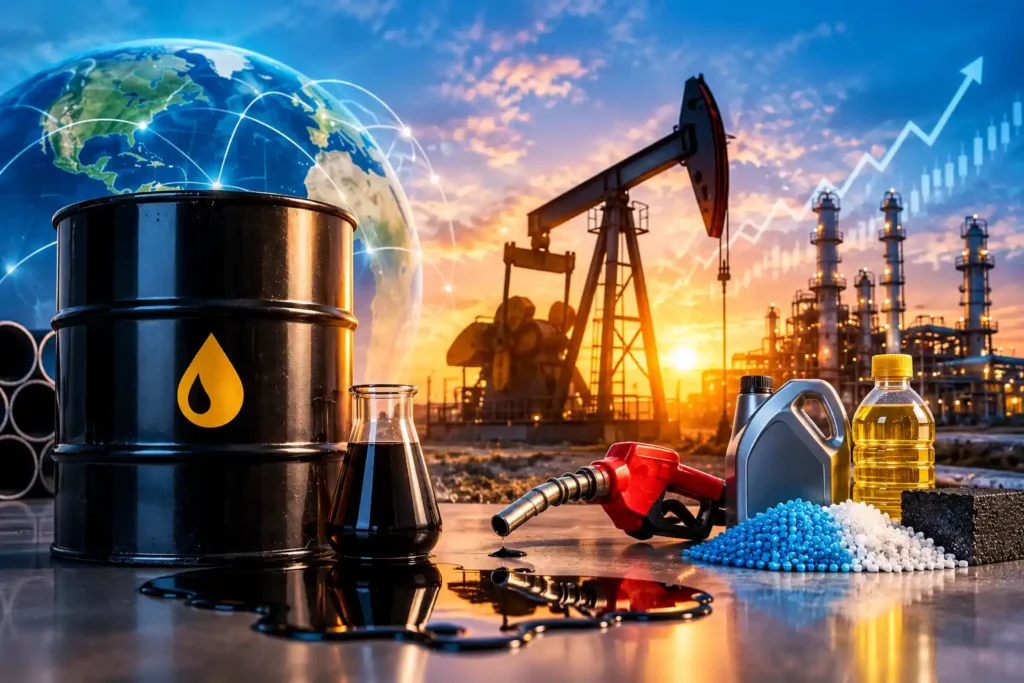
Petroleum is one of the world’s most important natural resources. It provides fuel for cars, trucks, airplanes, and ships while supplying raw materials for plastics, synthetic fabrics, lubricants, and many everyday products. Its influence extends beyond energy, affecting international trade, transportation costs, manufacturing, and the global economy.
Understanding what petroleum is, how it forms, and what petroleum is used for helps explain why oil markets attract attention from consumers, businesses, and governments. Changes in oil production, international conflicts, and fuel demand can influence petroleum prices and the cost of living.
Petroleum is also connected to products that people may not immediately associate with crude oil, including petroleum jelly, a refined substance commonly used to protect dry skin.
This guide explores petroleum’s meaning, composition, uses, major products, global oil market trends, fuel prices in Pakistan, environmental effects, and the difference between petroleum and petroleum jelly.
What Is Petroleum?
Petroleum is a naturally occurring mixture of hydrocarbons found in underground rock formations. Hydrocarbons are chemical compounds made primarily of carbon and hydrogen.
Petroleum forms over millions of years as ancient organic matter undergoes geological changes involving heat and pressure. Once extracted, crude oil can be processed in refineries to produce gasoline, diesel, jet fuel, lubricants, asphalt, and other useful materials.
Petroleum is classified as a nonrenewable fossil fuel because it takes much longer to form naturally than humans take to consume it.
Its importance comes from two main functions:
- Energy production: Petroleum provides fuels for transportation, heating, and certain industrial operations.
- Manufacturing: Petroleum-derived chemicals serve as raw materials for plastics, synthetic fibers, rubber, and other products.
Although petroleum is often called oil, the term can also refer to a broader group of oil-related substances and finished products.
ARTICAL: SoFi Stock: Price, Latest News, Earnings, and Forecast
Petroleum Definition and Meaning
The petroleum definition describes a naturally occurring mixture of hydrocarbons that accumulates beneath Earth’s surface.
In simple words, petroleum is a natural resource extracted from the ground and processed into fuels and materials used in everyday life.
The main characteristics of petroleum include:
- Origin: Ancient organic matter transformed through geological processes.
- Composition: Mainly carbon and hydrogen, with smaller amounts of other elements.
- Classification: Nonrenewable fossil fuel.
- Physical form: Commonly liquid crude oil, although petroleum deposits vary in composition.
- Main applications: Transportation, manufacturing, construction, and chemical production.
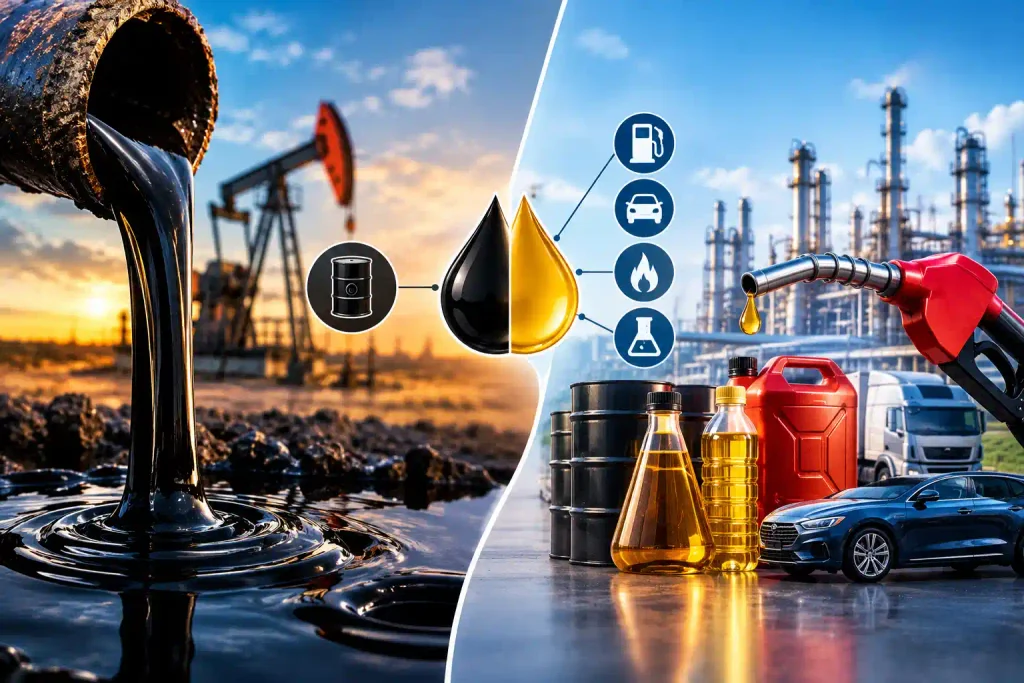
Crude oil is the unrefined liquid recovered from underground reservoirs. Petroleum products are the materials produced when crude oil is refined or processed.
This distinction is important because crude oil is the starting material, while gasoline, diesel, and asphalt are examples of products made from it.
How Is Petroleum Formed?
Petroleum forms through natural geological processes that take millions of years. Much of the conventional petroleum found today originated from microscopic organisms, such as algae and plankton, that lived in ancient aquatic environments.
When these organisms died, their remains accumulated in sediment. Additional layers of sediment gradually buried the organic material, exposing it to increasing heat and pressure.
Over geological time, these conditions transformed the material into hydrocarbons. The resulting petroleum could migrate through porous rocks and accumulate beneath layers of less permeable rock.
The formation process generally includes four stages:
- Organic matter accumulates: Ancient organisms die and settle in sediment.
- Sediment builds up: Layers of sediment bury the organic remains.
- Hydrocarbons develop: Heat and pressure transform the buried organic matter.
- Reservoirs form: Petroleum accumulates in suitable underground rock formations.
Geologists study these formations to identify potential oil deposits. Companies then use drilling and extraction technologies to recover petroleum for commercial use.
What Is Petroleum Made Of?
Petroleum is made primarily of hydrocarbons, but its exact chemical composition varies depending on its source.
The main hydrocarbon groups include alkanes, cycloalkanes, and aromatic hydrocarbons. Crude oil may also contain sulfur compounds, nitrogen, oxygen, and trace metals.
These components influence the quality of crude oil and the processes needed to refine it.
Two important characteristics are oil density and sulfur content.
Light crude oil is generally less dense and often easier to process into valuable fuels. Heavy crude oil contains a greater proportion of dense components and may require more complex refining.
Crude oil is also described as sweet or sour. Sweet crude contains relatively little sulfur, while sour crude contains more sulfur and may require additional treatment.
These differences matter because refineries use different processing methods to produce fuels that meet required quality and environmental standards.
What Is Petroleum Used For?
Petroleum has many applications beyond producing fuel for cars. It supports transportation, manufacturing, construction, and industrial activity.
Transportation Fuels
Gasoline and diesel power many road vehicles, while jet fuel supports commercial aviation. Petroleum-derived marine fuels also play a role in shipping.
These fuels help move passengers, food, raw materials, and manufactured goods across cities and countries.
Plastics and Synthetic Materials
Petroleum-derived chemicals are used to manufacture many plastics, synthetic fibers, and rubber products.
These materials appear in packaging, electronics, clothing, vehicle components, construction equipment, and household goods.
Lubricants and Motor Oils
Petroleum-derived lubricants reduce friction between moving parts in engines and machinery. They help limit wear and support reliable equipment performance.
Asphalt and Construction Materials
Asphalt and bitumen are used in road surfaces, roofing, and waterproofing applications. These materials help create durable surfaces and protect structures from moisture.
Heating and Industrial Energy
Certain petroleum products are used to heat buildings, operate industrial equipment, and support selected electricity-generation processes.
Chemicals and Consumer Products
Petroleum-derived feedstocks help produce detergents, solvents, paints, coatings, synthetic materials, and other industrial chemicals.
These applications explain why petroleum demand depends on industrial production and manufacturing as well as transportation.
What Are the Main Petroleum Products?
Petroleum refineries process crude oil into products with different characteristics and uses.
| Product | Common use |
| Gasoline | Cars, motorcycles, and compatible engines |
| Diesel | Trucks, buses, agricultural machinery, and diesel engines |
| Jet fuel | Aircraft |
| Kerosene | Certain heating and industrial applications |
| Liquefied petroleum gas (LPG) | Cooking, heating, and industrial use |
| Lubricating oil | Engines and machinery |
| Asphalt and bitumen | Roads, roofing, and waterproofing |
| Naphtha | Petrochemical manufacturing and industrial applications |
| Fuel oil | Selected industrial and marine applications |
The quantity of each product depends on crude oil composition, refinery equipment, processing methods, and market demand.
How Does Petroleum Refining Work?
Petroleum refining converts crude oil into fuels and materials suitable for commercial use.
First, crude oil is heated and separated into different fractions through distillation. These fractions contain hydrocarbons with different boiling ranges.
Next, refineries use conversion processes, such as cracking, to change the structure of certain hydrocarbons and increase the production of desired fuels.
Treatment processes remove or reduce impurities, including sulfur. Finally, different components are blended to produce finished fuels that meet required specifications.
The finished products are then transported to storage facilities, distributors, service stations, and industrial customers.
Refineries may adjust their operations according to seasonal demand, crude oil availability, fuel prices, and environmental regulations.
What Is the Difference Between Petroleum and Crude Oil?
Petroleum and crude oil are closely related terms, but their meanings can differ.
Crude oil is the unrefined liquid extracted from underground reservoirs. Petroleum is a broader term that may refer to crude oil and petroleum-derived products.
For example, gasoline is a petroleum product, but it is not unrefined crude oil.
This distinction is particularly useful when reading energy news. Crude oil prices reflect the market for raw oil, whereas gasoline and diesel prices also depend on refining costs, distribution expenses, taxes, and local market conditions.
Petroleum Jelly: What Is It and How Is It Made?
Petroleum jelly is a thick, semi-solid mixture of refined hydrocarbons derived from petroleum. It is also known as petrolatum or soft paraffin.
Unlike crude petroleum, petroleum jelly is a processed product used mainly for skin protection. It forms a protective layer that helps reduce moisture loss and protect dry or chapped skin. <Cite refs={[“turn922336search1”,“turn922336search3”]}/>
Petroleum jelly is commonly used in moisturizers, lip balms, and skin-protectant products. Its consistency helps create a barrier between the skin and the surrounding environment.
Although petroleum jelly originates from petroleum, it is chemically and physically different from crude oil. Products intended for skin use must undergo appropriate refining to remove unwanted impurities.
Is Vaseline Petroleum Jelly?
Yes. Vaseline Original Petroleum Jelly is a well-known branded petroleum jelly product. Its active ingredient is white petrolatum, which acts as a skin protectant. <Cite refs={[“turn922336search7”,“turn922336search11”]}/>
Petroleum jelly is the general product category, while Vaseline is a brand name. Other manufacturers also produce petroleum jelly, and formulations can vary by product.
When choosing a product, check its ingredient list, intended use, packaging, and manufacturer’s instructions.
What Are the Benefits of Petroleum Jelly?
Petroleum jelly helps protect skin by forming a barrier that reduces moisture loss. Common uses include:
- Protecting dry or chapped lips.
- Relieving dry, rough skin.
- Helping protect minor cuts and scrapes.
- Reducing moisture loss from exposed skin.
- Protecting skin from drying environmental conditions.
For minor skin problems, use a product according to its label. Deep wounds, serious burns, infected areas, and persistent skin problems may require medical advice. <Cite refs={[“turn922336search3”,“turn922336search11”]}/>
Is Petroleum Jelly Bad for You?
Petroleum jelly is generally considered safe for its intended skin-protection uses when it is properly refined and used as directed. However, safety depends on the product, how it is used, and the condition of the skin.
Some precautions are important:
- Use petroleum jelly intended for skin care rather than unrefined industrial petroleum products.
- Avoid getting it into the eyes or placing it inside the nose.
- Do not apply it to deep wounds or serious burns without appropriate medical advice.
- Avoid swallowing it. If a person chokes or has breathing difficulties after swallowing petroleum jelly, seek emergency medical assistance.
- Keep it away from open flames and other ignition sources, and follow product safety instructions.
People with unusual irritation or worsening symptoms should stop using the product and seek medical advice. <Cite refs={[“turn922336search3”,“turn922336search8”,“turn922336search11”]}/>
Does Petroleum Jelly Expire?
Yes, petroleum jelly products may have an expiration date or a recommended period of use printed on the packaging.
Because petroleum jelly is generally water-free, it can remain stable for a long time. However, storage conditions, packaging, added ingredients, and contamination can affect product quality.
To help maintain its quality:
- Check the expiration date and manufacturer’s instructions.
- Keep the container tightly closed.
- Store it in the recommended conditions.
- Use clean hands or a clean applicator when taking product from a jar.
- Discard the product if its color, smell, or consistency changes unexpectedly.
Do not assume that every petroleum jelly product has the same shelf life. Follow the directions for the specific product you own. <Cite refs={[“turn922336search2”,“turn922336search3”]}/>
Latest Petroleum Market Trends
Petroleum markets are influenced by global production, consumer demand, geopolitical developments, refinery activity, and transportation routes.
Several trends are important to watch when following oil-market news.
Global Oil Supply and Geopolitical Tensions
Conflicts, sanctions, and disruptions to oil infrastructure can affect production and transportation. Such events may increase uncertainty about the amount of petroleum reaching international markets.
The Strait of Hormuz is an important energy shipping route. Disruptions to shipping in this area can raise concerns about oil supply and transportation costs.
However, the effect on prices depends on the scale and duration of the disruption, available alternative supplies, and market expectations.
Oil Demand and Economic Growth
Petroleum demand is closely linked to transportation, industrial activity, and economic growth.
Stronger economic activity can increase fuel consumption, while slower growth and improved energy efficiency may reduce demand.
Changes in aviation, shipping, vehicle use, and petrochemical manufacturing can also influence petroleum consumption.
Refinery Operations and Fuel Prices
Crude oil prices do not always move in the same direction as gasoline or diesel prices. Refinery shutdowns, seasonal demand, and shortages of particular fuels can affect the prices of finished products.
For this reason, understanding the petroleum market requires looking at both crude oil and refined-fuel markets.
Renewable Energy and Electric Vehicles
Electric vehicles, renewable electricity, and energy-efficiency improvements may reduce petroleum consumption in some sectors.
However, aviation, shipping, heavy transport, and petrochemical manufacturing have different requirements and may continue to rely on petroleum or petroleum-derived materials.
For current market information, consult Reuters Commodities and the International Energy Agency’s Oil Market Reports.
Petroleum Prices in Pakistan
Petroleum prices in Pakistan affect motorists, transport companies, farmers, businesses, and households. Changes in petrol and diesel prices can influence the cost of travel and the transportation of goods.
Several factors contribute to domestic fuel prices:
- International crude oil and refined-fuel prices.
- The exchange rate between the Pakistani rupee and the US dollar.
- Import and transportation costs.
- Government taxes, duties, and applicable levies.
- Domestic fuel pricing decisions and supply conditions.
Pakistan’s reliance on imported petroleum makes international energy-market developments particularly important.
How Do Petrol Price Changes Affect Pakistan?
Higher petrol prices increase fuel expenses for many motorists and motorcyclists. Higher diesel prices can also affect freight transport, public transport, agricultural machinery, and the delivery of goods.
When businesses face increased transportation costs, some may pass those expenses on to customers. This can contribute to higher prices for certain products and services.
Lower fuel prices may ease some of these pressures, although the overall effect also depends on inflation, currency movements, and other business costs.
Because petroleum prices can change, check the latest announcements from Pakistan’s Petroleum Division before relying on a specific price per litre.
Major Petroleum-Producing Countries
Petroleum production is spread across several regions. Major producers include the United States, Saudi Arabia, Russia, Canada, Iraq, China, Brazil, the United Arab Emirates, and Iran.
Their relative importance varies according to the type of petroleum being measured, domestic consumption, and export capacity.
The Organization of the Petroleum Exporting Countries, or OPEC, is an important participant in global oil markets. Production decisions by OPEC members and other major producers can influence expectations about available supply.
However, no single country or organization determines oil prices alone. Demand, non-OPEC production, inventories, refinery capacity, and geopolitical events also play important roles.
Advantages of Petroleum
Petroleum has several practical and economic advantages.
- High energy content: Many petroleum fuels provide substantial energy relative to their volume.
- Versatile applications: Petroleum supports transportation, manufacturing, construction, and chemical production.
- Established infrastructure: Pipelines, refineries, storage facilities, and tankers support large-scale distribution.
- Industrial value: Petroleum-derived materials are used in many products and manufacturing processes.
- Economic activity: Petroleum production, refining, and distribution support jobs, investment, and trade.
These advantages help explain why petroleum remains an important part of the global economy.
Disadvantages of Petroleum
Despite its benefits, petroleum has environmental and economic disadvantages.
Climate Change
Burning petroleum fuels releases carbon dioxide, a greenhouse gas that contributes to global warming.
Pollution
Extraction, refining, transportation, and combustion can release pollutants. Oil spills may damage wildlife, marine ecosystems, and coastal communities.
Limited Natural Supply
Petroleum takes millions of years to form and is considered nonrenewable on a human timescale.
Price Volatility
International oil-price changes can affect household fuel bills, transportation expenses, and the cost of operating businesses.
Health and Safety Concerns
Some petroleum chemicals can be harmful under certain exposure conditions. Improper storage or handling can also create fire and contamination risks.
These challenges have encouraged improvements in fuel efficiency, pollution controls, and the development of alternative energy sources.
What Is the Future of Petroleum?
The future of petroleum will depend on energy demand, technology, environmental policies, and investment in alternative energy sources.
Petroleum is expected to remain relevant in many industrial applications, while electric vehicles and renewable energy may reduce demand in some areas.
Important developments to monitor include changes in global oil production, refinery investment, electric-vehicle adoption, energy-efficiency standards, and demand for petrochemical materials.
The transition will differ between countries because their energy needs, infrastructure, and access to technology are not the same.
Understanding these developments helps readers evaluate petroleum’s role in future energy systems without assuming that demand will either disappear immediately or remain unchanged.
Frequently Asked Questions About Petroleum
What is petroleum?
Petroleum is a naturally occurring mixture of hydrocarbons found beneath Earth’s surface. It is extracted as crude oil and processed into fuels, lubricants, and industrial materials.
What is petroleum used for?
Petroleum is used to produce gasoline, diesel, jet fuel, lubricants, asphalt, plastics, synthetic materials, and various industrial chemicals.
What is petroleum made of?
Petroleum consists mainly of hydrocarbons containing carbon and hydrogen. It can also contain sulfur, nitrogen, oxygen, and trace metals.
Is petroleum the same as crude oil?
Crude oil is the unrefined liquid extracted from underground reservoirs. Petroleum is a broader term that may include crude oil and petroleum-derived products.
What is petroleum jelly?
Petroleum jelly, also called petrolatum, is a refined semi-solid mixture of hydrocarbons derived from petroleum. It is commonly used to protect dry skin and chapped lips.
Is Vaseline petroleum jelly?
Yes. Vaseline Original Petroleum Jelly is a branded product made with white petrolatum. Petroleum jelly is the general product category, while Vaseline is a brand name.
Is petroleum jelly bad for you?
Properly refined petroleum jelly is generally safe for its intended skin-protection uses. Use it according to the product label, avoid inhaling or swallowing it, and seek medical advice for serious wounds or adverse reactions.
Does petroleum jelly expire?
Petroleum jelly products may have an expiration date printed on their packaging. Check the date, follow storage instructions, and discard products with unexpected changes in smell, color, or consistency.
Why do petroleum prices change?
Petroleum prices change in response to supply and demand, geopolitical events, shipping costs, refinery activity, currency movements, and government policies.
Is petroleum a renewable resource?
No. Petroleum is a nonrenewable fossil fuel because it takes millions of years to form naturally.
Conclusion
Petroleum is a major natural resource that supports transportation, manufacturing, construction, and international trade. Its composition and refining process determine how crude oil becomes useful fuels and industrial materials.
Understanding petroleum also means recognizing its wider connections. Global oil-market developments can affect fuel prices in Pakistan, while refined petroleum products such as petroleum jelly have separate everyday applications.
By learning about petroleum’s definition, uses, products, market trends, and environmental effects, readers can better understand its continuing role in the global economy and the changes shaping the future of energy.