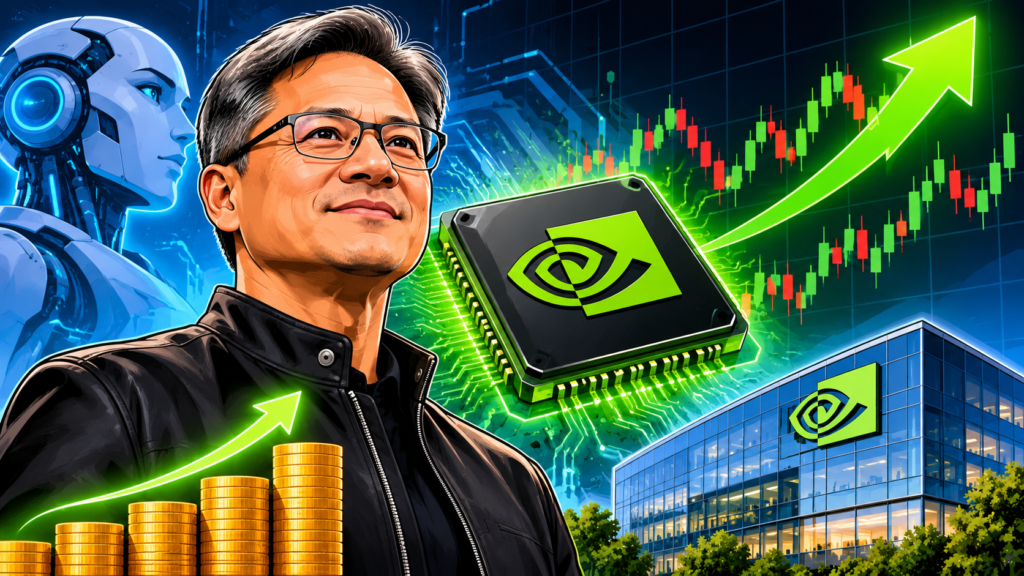
The NVDA stock price remains one of the most closely watched figures in the technology and financial markets. NVIDIA Corporation has become a major force in artificial intelligence (AI), data centers, gaming, and advanced computing. Its graphics processing units (GPUs) power many of the systems behind modern AI applications, making the company an important name for investors following the technology sector.
However, NVIDIA shares can experience significant price movements when investors react to earnings reports, competition, economic conditions, or company-related news. Recent developments involving CEO Jensen Huang have added another layer of uncertainty to the stock.
This guide explores the NVIDIA stock price, recent market developments, company performance, AI growth, upcoming earnings, and the factors that could influence NVDA shares in the months ahead.
NVDA Stock Price and Recent Market Performance
NVIDIA trades on the Nasdaq stock exchange under the ticker symbol NVDA. Investors can follow its share price through financial platforms, brokerage accounts, and stock market websites.
On November 9, 2026, NVIDIA shares faced significant selling pressure following reports about an independent board investigation involving CEO Jensen Huang. The stock had closed the previous Friday at $186.64. Associated market reports showed an overnight trading price near $180.30, while an Associated Press report recorded a decline to $172.37 during Monday’s early trading.
These figures represent different trading periods rather than one fixed quote. The NVDA stock price changes throughout regular market hours and may also move during pre-market and after-hours sessions.
Investors checking the latest NVDA stock quote should pay attention to:
- Current share price: The latest available trading price for one NVIDIA share.
- Previous close: The stock’s final price during the previous regular trading session.
- Daily trading range: The highest and lowest prices recorded during the session.
- Trading volume: The number of shares exchanged between buyers and sellers.
- Market capitalization: The total market value of NVIDIA’s outstanding shares.
- 52-week range: The highest and lowest prices reached over the previous year.
These measurements help explain daily price movements and provide context for longer-term performance.
ARTICAL: Karlie Kloss: Biography, Husband, Taylor Swift Reunion, Career and Latest News in 2026
Why NVIDIA Shares Are in the Spotlight in November 2026
NVIDIA has recently attracted attention for two major reasons: continued demand for AI computing and developments involving its leadership.
The company’s AI business remains central to its long-term growth story. At the same time, reports about an investigation into whether Jensen Huang was targeted by a foreign intelligence effort have raised questions about governance and potential regulatory attention.
According to reports published on November 9, NVIDIA’s board said it had no reason to believe that company secrets or national security interests had been compromised. The company initiated an investigation with independent directors and outside legal assistance. The allegations and investigation should not be treated as proof that confidential information was disclosed.
The news nevertheless unsettled investors because Huang has played a central role in NVIDIA’s development and business strategy. Any uncertainty surrounding the company’s leadership can influence investor confidence, particularly when a company’s valuation depends heavily on expectations for future growth.
The situation also brings attention to the wider debate around advanced semiconductor exports, especially restrictions affecting China’s access to high-performance AI chips.
For shareholders, the key questions are whether the investigation affects company operations, whether it leads to additional regulatory scrutiny, and whether NVIDIA can maintain its growth momentum.
What Makes NVIDIA Corporation So Important?
NVIDIA Corporation was founded in 1993 and initially became widely recognized for developing graphics processing units used in personal computers and gaming systems.
Over time, the company expanded beyond gaming. Its GPU technology became important for scientific research, cloud computing, machine learning, and large-scale artificial intelligence.
Today, NVIDIA operates across several major technology markets.
Artificial Intelligence and Machine Learning
AI is one of the biggest drivers of NVIDIA’s business. Training and running advanced AI models requires substantial computing power, and NVIDIA GPUs are widely used for these workloads.
Companies developing generative AI tools, language models, recommendation systems, and autonomous technologies rely on powerful computing infrastructure.
This demand has helped make NVIDIA a central supplier in the expanding AI industry.
Data Center Technology
Data centers are another major source of NVIDIA’s revenue. Cloud providers, technology companies, and businesses are investing in specialized infrastructure to support AI applications.
NVIDIA supplies GPUs, networking equipment, software, and complete computing systems designed for these environments.
As organizations expand their AI capabilities, demand for data center computing products could remain an important factor in the company’s financial performance.
Gaming and Graphics Cards
Gaming remains an important part of NVIDIA’s identity. Its GeForce graphics cards are used by PC gamers, content creators, and professionals who need high-performance graphics processing.
Although AI and data centers have become major growth engines, gaming continues to give NVIDIA access to a large consumer technology market.
Automotive and Robotics
NVIDIA also develops computing platforms for autonomous vehicles, robotics, and other physical AI applications.
These markets may offer additional growth opportunities as manufacturers introduce more advanced automation and intelligent systems.
NVIDIA’s Financial Results: What Investors Should Know
A company’s stock price is closely connected to its ability to generate revenue, maintain profits, and meet market expectations. NVIDIA’s latest reported quarterly results provide useful insight into the strength of its business.
For the second quarter of fiscal 2027, which ended on July 26, 2026, NVIDIA reported:
Financial metricQ2 FY2027 result
Total revenue $96.2 billion
Year-over-year revenue growth 106%
Data Center revenue $89.0 billion
Data Center year-over-year growth 117%
GAAP gross margin 75.0%
GAAP net income $59.7 billion
GAAP diluted EPS $2.46
These results demonstrate how strongly NVIDIA’s business has benefited from demand for AI infrastructure.
The Data Center division generated most of the company’s quarterly revenue. This makes the performance of cloud providers, AI developers, and enterprise technology spending particularly important to NVIDIA’s outlook.
The company also provided third-quarter fiscal 2027 revenue guidance of approximately $108 billion, plus or minus 2%. NVIDIA stated that this outlook did not assume Data Center compute revenue from China.
Strong revenue growth can support investor confidence, but the market also considers profitability, future guidance, operating costs, and whether results exceed expectations.
How AI Demand Could Influence the NVDA Share Price
Artificial intelligence has become a major investment theme across the global technology industry. Businesses are using AI to automate tasks, analyze information, develop software, and improve customer service.
This shift requires powerful hardware and computing infrastructure.
NVIDIA benefits from this demand because its products are used to train and operate many advanced AI systems. Its technology also includes networking products and software that help customers build large-scale AI environments.
Several developments could influence future demand:
- Generative AI adoption: More businesses are integrating AI assistants and automated tools into their operations.
- Cloud infrastructure spending: Major cloud providers continue investing in computing capacity.
- AI model development: More advanced models can require substantial computing resources.
- Enterprise adoption: Companies are exploring AI applications in finance, healthcare, manufacturing, and other industries.
- Physical AI: Robotics and autonomous systems could create additional demand for specialized computing.
However, strong industry growth does not guarantee that NVIDIA shares will rise. Investors must also consider the price they are paying for the company’s expected future earnings.
Blackwell and Vera Rubin: NVIDIA’s Next Technology Drivers
NVIDIA’s product roadmap is another important factor behind investor interest in NVDA stock.
The company’s Blackwell architecture has been designed for demanding AI and accelerated-computing workloads. Its systems are used in data center infrastructure where performance, power efficiency, and networking are important.
NVIDIA has also highlighted its Vera Rubin platform as a next-generation AI computing system. In its August 2026 financial announcement, the company said Vera Rubin had entered full production.
These platforms matter because customers need increasingly powerful systems to train and operate advanced AI models.
The successful rollout of new products could support revenue growth. However, production delays, supply constraints, higher costs, or weaker customer spending could affect results.
Investors should therefore monitor product availability and customer adoption rather than assuming that every new technology announcement will immediately translate into higher earnings.
What Could Cause the NVDA Stock Price to Drop?
Even a company with strong financial results can experience a decline in its share price. NVIDIA is particularly sensitive to changes in investor expectations because the stock is closely linked to the AI growth narrative.
Several factors can put pressure on the NVDA stock price.
Leadership and Corporate Governance Concerns
The November 2026 investigation involving Jensen Huang has introduced uncertainty about leadership and corporate governance.
Because Huang has been closely associated with NVIDIA’s strategy and growth, investors may react negatively to developments that create doubts about management stability.
Concerns About AI Spending
NVIDIA depends heavily on companies investing in AI infrastructure. If major technology companies reduce their spending or delay data center projects, demand for GPUs and related products could weaken.
Even rumors of slower AI investment can affect market sentiment.
Competition From AMD and Custom Chips
Advanced Micro Devices (AMD) competes with NVIDIA in the GPU market. In addition, major technology companies are developing custom chips for their own AI workloads.
If customers increasingly use alternative hardware, NVIDIA could face pressure on market share, pricing, or profit margins.
U.S. Export Restrictions and China Exposure
Restrictions on advanced semiconductor exports can limit the markets available to NVIDIA.
China is particularly important in discussions about chip sales and international technology competition. Changes in export rules could affect potential revenue and create uncertainty for investors.
High Valuation and Market Expectations
Investors may already expect substantial future growth from NVIDIA. When expectations become very high, even positive earnings can disappoint if results or guidance fall short of forecasts.
This is why valuation metrics and future earnings estimates matter alongside revenue growth.
NVIDIA Earnings: Why November 17 Matters
NVIDIA’s next reported earnings event was scheduled for November 17, 2026, according to market coverage available on November 9.
The report is important because investors will look for evidence that AI infrastructure demand remains strong and that the company can deliver on its previous guidance.
Some of the most closely watched figures will include:
- Quarterly revenue and year-over-year growth.
- Data Center revenue and customer demand.
- Earnings per share compared with analyst expectations.
- Gross margin and operating expenses.
- Management’s guidance for the following quarter.
- Updates on Blackwell and Vera Rubin production.
- Any comments about export restrictions and international markets.
The earnings announcement could influence the stock’s short-term direction. However, investors may also focus on management’s response to the ongoing board investigation and related governance questions.
A strong financial report may support confidence in the business, but it may not immediately resolve concerns unrelated to quarterly performance.
NVDA Stock Price Outlook: What Could Happen Next?
Predicting exactly how high NVIDIA shares can go is difficult. The stock’s future performance will depend on business growth, market conditions, valuation, and investor sentiment.
There are several reasons investors remain interested in NVIDIA.
First, AI adoption continues to create demand for advanced computing. Second, NVIDIA has an established position in the GPU market and a broad technology ecosystem. Third, its data center business has become a significant source of revenue.
However, the company also faces risks. Competition is increasing, export rules can change, and investors may become less willing to pay high valuations for technology stocks.
The November 2026 leadership investigation adds another variable that could influence short-term trading.
Rather than relying on one price target, investors can assess different scenarios:
Bullish scenario: AI infrastructure spending remains strong, NVIDIA continues delivering new products, and revenue growth exceeds expectations. This could support higher earnings estimates and a stronger share price.
Neutral scenario: NVIDIA maintains solid business growth, but competition, valuation concerns, and market volatility limit share-price gains.
Bearish scenario: AI spending slows, regulatory pressure increases, leadership uncertainty continues, or competitors gain market share. These developments could lead to lower earnings expectations and additional selling pressure.
Analyst price targets can provide insight into market expectations, but they are estimates rather than guarantees.
How to Follow the NVIDIA Stock Quote
Investors can monitor the NVIDIA share price through financial news platforms, stock market websites, and brokerage services.
When checking the stock price of NVDA, it is useful to review more than the latest trading number.
Consider these indicators:
- Price history: Compare daily, monthly, and yearly performance to understand the broader trend.
- Trading volume: Higher-than-usual volume can indicate increased investor activity.
- Moving averages: These can help identify potential price trends over different periods.
- Relative strength index (RSI): Some traders use RSI to assess momentum and possible overbought or oversold conditions.
- Earnings reports: Quarterly results can reveal whether company performance supports market expectations.
- Analyst estimates: Review changes in revenue, earnings, and valuation forecasts.
Investors should also distinguish between regular-session prices and extended-hours trading. After-hours prices can move sharply and may not represent the price available when the regular market opens.
Is NVIDIA Stock Worth Watching in 2026?
NVIDIA remains an important company to follow because of its role in artificial intelligence, data centers, gaming, and advanced computing.
Its latest reported financial results show substantial revenue growth, especially in the Data Center division. The company’s product roadmap and continued investment in AI infrastructure also provide potential long-term growth opportunities.
At the same time, investors should not ignore the risks. Leadership uncertainty, export restrictions, competition, market volatility, and high expectations can all affect the NVDA stock price.
Anyone researching NVIDIA shares should compare the current valuation with expected earnings growth, review the company’s financial statements, and consider their own investment goals and risk tolerance.
The most useful approach is to evaluate NVIDIA as a business rather than making decisions based only on daily stock-price movements.
Frequently Asked Questions About NVDA Stock Price
1. What Is NVDA Stock Price?
NVDA is the Nasdaq ticker symbol for NVIDIA Corporation. Its stock price represents the market value of one NVIDIA share at a particular moment. The price changes during trading as buyers and sellers respond to company news, financial results, industry developments, and broader market conditions. For the latest quote, check a live financial platform or brokerage account.
2. What Is the Stock Price of NVDA?
The stock price of NVDA is the latest amount investors are willing to pay for one NVIDIA share in the market. It is quoted in U.S. dollars and changes throughout the trading session. Always check the quote’s timestamp because pre-market, regular-session, and after-hours prices can differ.
3. What Is the Price of NVDA Stock?
The price of NVDA stock is determined by supply and demand in the stock market. Investor expectations about NVIDIA’s earnings, AI chip demand, product launches, competition, and future growth can influence how much buyers are willing to pay. Economic conditions and major company announcements can also cause sudden price changes.
4. Why Is NVDA Stock Price Dropping?
The NVDA stock price can fall when investors become concerned about company performance, leadership, competition, regulation, or the broader technology market. In November 2026, shares came under pressure following news of a board investigation involving CEO Jensen Huang. Concerns about AI spending and semiconductor export restrictions can also affect investor sentiment.
5. How High Can NVDA Stock Price Go?
There is no reliable way to know the maximum price NVIDIA shares could reach. Future gains would depend on revenue growth, AI demand, earnings, competition, and market valuation. Analysts publish price targets based on their expectations, but these estimates can change and are not guaranteed outcomes. Investors should consider both potential gains and the risk of losses.
SOURCE: CNN