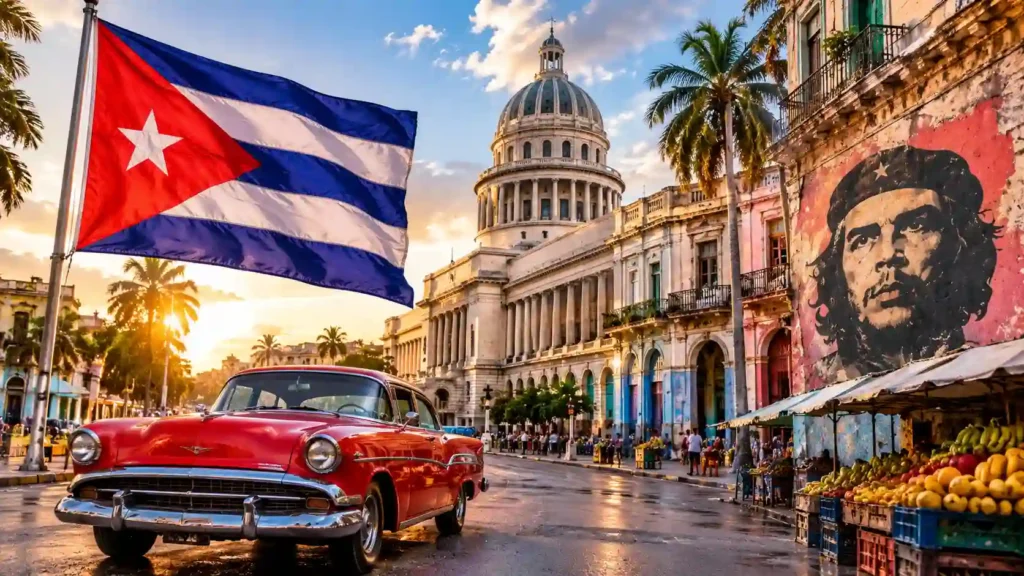
Cuba is a Caribbean island nation that continues to attract worldwide attention because of its political history, economic struggles, cultural influence, and complicated relationship with the United States. Known for its colorful streets, historic architecture, tropical beaches, classic American cars, and revolutionary past, Cuba is one of the most distinctive countries in the Americas.
However, there is much more to Cuba than its tourist attractions. In 2026, the country is facing serious economic and humanitarian challenges, including fuel shortages, electricity blackouts, rising living costs, declining tourism, and increasing pressure from US sanctions. These developments have made Cuba an important subject in international news and political discussions.
People searching for Cuba often want to understand whether it is an independent country, where it is located, how its government operates, and why it is frequently mentioned in global headlines.
Cuba is an independent country in the Caribbean Sea, south of Florida and east of Mexico. Its official name is the Republic of Cuba, its capital is Havana, and Spanish is its official language. The country follows a socialist political system led by the Communist Party of Cuba.
This guide covers everything readers need to know about Cuba, from its geography and history to its government, economy, tourism industry, and the latest developments shaping the country in November 2026.
Is Cuba an Independent Country?
Yes, Cuba is an independent and sovereign country. It is not part of the United States, Mexico, or any other nation. Cuba has its own government, constitution, national flag, currency, laws, and international diplomatic relationships.
The country’s official name is the Republic of Cuba. It became independent from Spanish colonial rule in 1898, although it remained under US military administration until the establishment of the Cuban Republic on May 20, 1902.
Cuba is internationally recognized and became a member of the United Nations on October 24, 1945.
Its political system is different from that of many neighboring countries. The Communist Party of Cuba has a constitutionally established leading role in the country’s political and social structure.
One reason people frequently ask whether Cuba is part of America is its geographical proximity to Florida. Despite being only around 150 kilometers from Key West, Cuba is a separate nation with its own political identity.
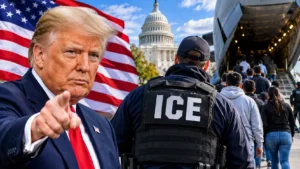
ARTICAL: Immigration in the United States 2026: Latest News, ICE Updates, Deportation, Laws and Immigrant Rights
Where Is Cuba Located?
Cuba is located in the northern Caribbean Sea, near the meeting point of the Caribbean Sea, the Gulf of Mexico, and the Atlantic Ocean.
The country lies south of Florida, east of Mexico’s Yucatán Peninsula, west of Haiti, and north of Jamaica. Its geographical position makes it an important part of the Greater Antilles, a group of major Caribbean islands.
Cuba’s location has influenced its history, international trade, tourism, migration, and political relationships.
The country is also the largest island nation in the Caribbean, making it geographically significant in the region.
Which Countries Are Closest to Cuba?
Several countries and territories are located near Cuba:
- United States: Florida lies north of Cuba across the Florida Straits.
- Mexico: The Yucatán Peninsula is located west of the island.
- Bahamas: The islands are situated northeast of Cuba.
- Haiti: Located east of Cuba across the Windward Passage.
- Jamaica: Found south of Cuba.
- Dominican Republic: Located farther east on the island of Hispaniola.
Although these countries share the Caribbean region, their political systems, economies, and cultures are different.
Cuba Country Profile: Important Facts and Figures
The following information provides a quick overview of the country.
CategoryDetails
Official name Republic of Cuba
Capital Havana
Location Caribbean Sea
Region Greater Antilles
Official language Spanish
Currency Cuban peso (CUP)
Government system Socialist one-party republic
Main political party Communist Party of Cuba
President Miguel Díaz-Canel
Population Approximately 10.94 million (2025 UN estimate)
Total area 109,884 square kilometers
Independence from Spain 1898
Republic established May 20, 1902
UN membership October 24, 1945
Why Is Cuba in the News in November 2026?
Cuba is receiving international attention because several developments are affecting its economy, political environment, and everyday life.
The most important stories involve US sanctions, energy shortages, food insecurity, tourism losses, and economic reforms.
Cuba’s Economic Crisis Is Affecting Ordinary Families
One of the biggest challenges facing Cuba in 2026 is its worsening economic situation.
Many households are struggling with low incomes, rising prices, limited access to food, and shortages of essential products. The financial pressure has become particularly difficult for retirees, public-sector workers, and families without financial support from relatives abroad.
A recent Associated Press report in November 2026 described how community kitchens and food assistance programs in Havana are helping increasing numbers of people who cannot afford enough groceries.
Some of these services provide meals to elderly residents, working adults, and families with children. This shows that the economic crisis is affecting people across different sections of Cuban society.
Several factors contribute to the situation, including inflation, declining tourism revenue, limited foreign currency, import difficulties, domestic economic weaknesses, and international sanctions.
Electricity Blackouts and Fuel Shortages Continue to Cause Problems
Cuba’s energy system is another major concern.
The country relies heavily on imported fuel, while many of its power plants and electricity networks require maintenance and investment. Limited fuel supplies and infrastructure problems have contributed to repeated power interruptions.
Electricity shortages affect much more than household lighting. They can disrupt hospitals, water supplies, transportation, food refrigeration, schools, communication networks, and businesses.
For ordinary residents, prolonged blackouts can make daily activities extremely difficult.
Fuel shortages also affect public transportation, agriculture, and the delivery of essential products.
The energy crisis has become one of the central issues in discussions about Cuba’s economic future.
US Expands Economic Sanctions Against Cuba
Relations between Cuba and the United States remain a major international story.
In November 2026, the Trump administration expanded its economic pressure campaign against Cuba, announcing additional sanctions targeting sectors including electronics, manufacturing, maritime activity, and technology.
The restrictions also involved Chinese entities accused by Washington of supplying equipment connected to Cuba’s government and security activities.
The US administration says its policies are intended to pressure Cuba’s leadership over political and national security concerns.
Cuba, however, has repeatedly criticized American sanctions, arguing that they contribute to economic hardship and restrict access to international trade and resources.
The United Nations General Assembly also condemned the US economic embargo for the 34th consecutive year in October 2026.
These developments are important because Cuba depends on international suppliers for fuel, machinery, technology, and other essential imports.
Cuba’s Tourism Industry Is Experiencing Difficulties
Tourism has traditionally been one of Cuba’s most important sources of foreign currency.
International visitors travel to the country for its beaches, historic cities, music, architecture, and cultural experiences.
However, the industry has experienced a significant decline in 2026.
According to figures reported in September 2026, international visitor arrivals fell by approximately 62% between January and July compared with the same period in 2025.
Several issues have contributed to this decline:
- Fuel shortages affecting transportation.
- Electricity interruptions in tourist areas.
- Reduced international travel services.
- Economic uncertainty.
- Limited availability of some essential services.
- Concerns about the reliability of tourism infrastructure.
The decline affects hotels, restaurants, private accommodation providers, tour operators, drivers, and small businesses.
Because tourism supports thousands of livelihoods, its recovery is important for Cuba’s wider economy.
Government Introduces New Economic Reforms
Despite the country’s difficulties, Cuba is attempting to introduce changes to its economic system.
In June 2026, the government announced a significant package of economic reforms designed to encourage private enterprise and investment.
Additional regulations introduced in September aimed to simplify procedures for foreign investment, improve business operations, and expand opportunities in tourism and international trade.
Some measures provide private companies with greater flexibility in hiring employees and conducting commercial activities.
These changes are significant because Cuba has traditionally maintained extensive state control over its economy.
However, the success of these reforms will depend on implementation, access to investment, productivity, and the country’s broader political and economic conditions.
Who Is Leading Cuba in 2026?
Miguel Díaz-Canel is the president of Cuba. He took office in April 2018 and began his second presidential term in April 2023.
He also serves as the first secretary of the Communist Party of Cuba, which has a central role in the country’s political system.
His leadership has coincided with major economic difficulties, public dissatisfaction, international sanctions, migration, and energy shortages.
The government has attempted to respond through economic reforms and changes to certain business regulations, but the country continues to face substantial challenges.
Understanding Cuba’s leadership is important because political decisions influence trade, investment, public services, and international relations.
How Does Cuba’s Political System Work?
Cuba follows a socialist political system in which the Communist Party plays a leading constitutional role.
Its government includes several important institutions:
- President: Serves as head of state.
- Prime Minister: Oversees the Council of Ministers and government administration.
- National Assembly: Acts as the country’s legislative body.
- Communist Party: Provides political leadership and influences national policy.
Cuba does not operate a conventional multiparty political system in which competing political parties regularly alternate in national government.
The country’s political structure remains a subject of international discussion, particularly concerning elections, freedom of expression, human rights, and political participation.
Why Are Cuba and the United States Constantly in Conflict?
The relationship between Cuba and the United States has been complicated for decades.
Although the two countries are geographically close, disagreements over political ideology, economic policy, national security, and international influence have created long-lasting tensions.
The situation changed dramatically after the Cuban Revolution in 1959, when Fidel Castro’s revolutionary government took power.
The new government introduced socialist economic policies and developed close relations with the Soviet Union. This created serious disagreements with Washington.
Understanding the US Embargo Against Cuba
The US embargo is a collection of trade and economic restrictions that limit many financial and commercial activities involving Cuba.
It began in the early 1960s and has remained an important issue in US foreign policy.
The restrictions have affected trade, investment, banking, and access to certain international markets.
The US government argues that sanctions are intended to pressure Cuba’s political leadership. The Cuban government argues that the embargo contributes to shortages, economic difficulties, and limited development opportunities.
The disagreement has continued through different American administrations.
What Is Happening Between Washington and Havana Now?
In 2026, relations remain strained as the Trump administration has increased economic pressure through additional sanctions and restrictions.
The Cuban government continues to reject Washington’s policies and argues that external pressure is worsening conditions for ordinary residents.
The dispute has also attracted international attention because other countries maintain economic and diplomatic relationships with Cuba.
Future changes in sanctions, trade arrangements, and diplomatic negotiations could significantly influence the island’s economy.
Why Are Many Cubans Moving Abroad?
Migration is one of the most important social and demographic issues facing Cuba.
Many Cubans have moved abroad in search of better employment, higher incomes, improved living conditions, and more economic opportunities.
Common reasons include:
- Rising prices and inflation.
- Limited employment opportunities.
- Shortages of food and medicines.
- Frequent electricity interruptions.
- Economic and political uncertainty.
- Family reunification.
The migration trend has affected the country’s population structure and workforce.
When younger people and skilled professionals leave, industries such as healthcare, education, agriculture, and technology can experience difficulties finding qualified workers.
Migration also affects families who remain in Cuba, particularly when they depend on financial assistance from relatives living overseas.
The long-term impact of this population movement will be an important factor in Cuba’s future development.
What Is Cuba’s Economy Based On?
Cuba has a state-led economy with an expanding private sector in certain areas.
Its main economic activities include tourism, agriculture, healthcare, biotechnology, mining, and professional services.
However, the country has experienced economic contraction, limited investment, inflation, and difficulties accessing international financing.
Tourism and Hospitality
Tourism is an important source of foreign currency and employment.
Hotels, restaurants, private guesthouses, transportation companies, and travel businesses depend on international visitors.
Havana, Varadero, Trinidad, and Viñales are among the country’s best-known destinations.
Agriculture and Food Production
Cuba produces sugarcane, tobacco, coffee, rice, vegetables, and tropical fruits.
Agriculture has historically been important to the country’s economy, but production challenges and dependence on food imports remain significant concerns.
Healthcare and Biotechnology
Cuba has developed a recognized public healthcare and medical research sector.
The country has invested in medical education, pharmaceutical research, biotechnology, and vaccine development.
These industries are also part of Cuba’s international identity.
Mining and Natural Resources
Nickel and cobalt are among Cuba’s important mineral resources.
The country also has deposits of iron ore, copper, chromium, and other materials.
Mining provides export opportunities, although infrastructure, investment, and international market conditions influence production.
What Currency and Language Does Cuba Use?
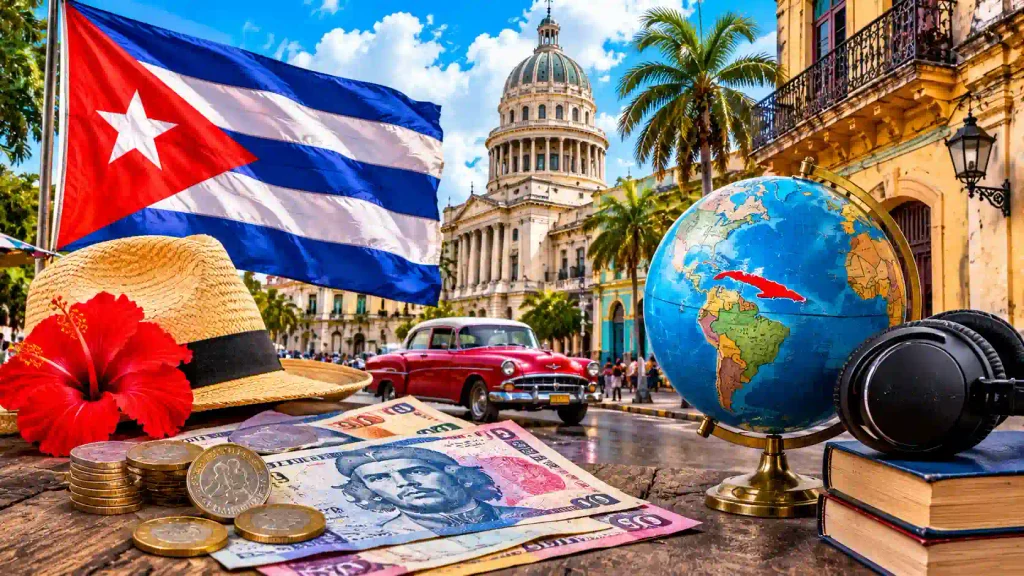
The official currency of Cuba is the Cuban peso, known as CUP.
It is used for everyday transactions, including local purchases, transportation, and many domestic services.
Currency reforms, inflation, and exchange-rate differences have made the financial situation more complicated for residents and businesses.
Spanish is the official language and the most widely spoken language in the country.
Cuban Spanish has a distinctive Caribbean accent and vocabulary, reflecting the country’s historical connections with Spain, Africa, and other Caribbean societies.
English is understood in some hotels and tourist areas, but Spanish remains the main language of everyday communication.
What Makes Cuban Culture Different?
Cuba has a distinctive cultural identity shaped by Spanish, African, and Caribbean influences.
Its music, dance, architecture, food, sports, and religious traditions have influenced communities around the world.
Music is especially important in Cuban society. Genres such as son, salsa, rumba, and mambo have become internationally recognized.
Cuban dance traditions are also popular, with music playing a central role in festivals, celebrations, and everyday social life.
Food is another important part of the country’s identity. Traditional dishes often include rice, beans, plantains, pork, and seafood.
The country’s historic architecture and classic American cars are also recognizable symbols of Cuban culture.
Which Places Make Cuba Famous Around the World?
Cuba offers a combination of historic attractions, beaches, natural landscapes, and cultural destinations.
Some of its most recognizable locations include:
Havana: The capital is famous for Old Havana, colonial architecture, museums, historic squares, and waterfront views.
Varadero: A popular beach destination known for its white sand and clear Caribbean waters.
Trinidad: A historic town recognized for its preserved colonial streets and traditional architecture.
Viñales Valley: Known for limestone hills, tobacco farms, and rural landscapes.
Santiago de Cuba: An important cultural city associated with Cuban music, history, and revolutionary events.
These destinations help explain why Cuba has remained attractive to international travelers despite its economic difficulties.
Visitors planning trips in 2026 should check current travel advisories, airline services, accommodation availability, fuel conditions, and payment arrangements.
What Could Shape Cuba’s Future?
Cuba’s future will depend on how successfully the country addresses its economic, political, and infrastructure challenges.
Reliable electricity, improved fuel supplies, stronger food production, and better access to essential goods will be important for improving living conditions.
Economic reforms could create opportunities for private businesses and international investors, but their success will depend on practical implementation.
Relations with the United States will also remain important. Changes in sanctions, trade restrictions, and diplomatic negotiations could influence Cuba’s access to international markets.
Migration is another long-term concern because the departure of younger residents and skilled workers can affect the country’s development.
These issues make Cuba an important country to follow in international news throughout 2026 and beyond.
Conclusion
Cuba is an independent island country in the Caribbean with a distinctive history, political system, and cultural identity.
Its capital, Havana, is internationally recognized for its historic architecture, while its beaches, music, food, and traditions make it one of the region’s most recognizable destinations.
However, Cuba is currently facing serious economic and humanitarian challenges. Fuel shortages, electricity blackouts, inflation, declining tourism, migration, and renewed US sanctions have placed additional pressure on the country.
At the same time, the government is exploring economic reforms and new investment opportunities.
Understanding Cuba requires looking at both its historical background and its current situation. Whether someone wants to know where Cuba is located, how its political system works, or why it is trending in 2026, these developments provide a broader understanding of the country.
Frequently Asked Questions About Cuba
1. Why does Cuba have so many classic American cars?
Many American cars remained in Cuba after the 1959 revolution and the introduction of US trade restrictions. Limited access to new imported vehicles encouraged owners and mechanics to maintain older cars using replacement parts and creative repairs. These vehicles have since become a recognizable part of Cuban culture.
2. What happened during the Cuban Missile Crisis?
The Cuban Missile Crisis occurred in October 1962, when the United States discovered Soviet nuclear missile installations in Cuba. The confrontation brought the world close to nuclear war. It ended after negotiations between US President John F. Kennedy and Soviet leader Nikita Khrushchev.
3. Does Cuba have its own military?
Yes. Cuba maintains its own armed forces, officially known as the Revolutionary Armed Forces. They are responsible for national defense and include military personnel and different service branches.
4. Does Cuba have a close relationship with Russia?
Cuba and Russia have historical political and economic connections dating back to the Soviet era. They continue to maintain diplomatic relations and cooperation, although their relationship has changed significantly since the Soviet Union collapsed.
5. Can foreign citizens own property in Cuba?
Foreign property ownership is subject to Cuban laws and restrictions. Certain investment and property arrangements are possible, but foreigners should not assume that they can purchase residential property under the same conditions available in many other countries. Legal advice and official verification are important before making any investment.
6. What products does Cuba export to other countries?
Cuba has historically exported nickel, cobalt, tobacco, cigars, sugar, seafood, and pharmaceutical products. Its export performance depends on international demand, production capacity, trade relationships, and access to investment.
7. How does education work in Cuba?
Cuba has a state-supported education system that includes primary, secondary, and university-level education. Education has historically been an important national priority, although economic difficulties can affect school facilities, supplies, transportation, and staffing.
8. Why is Cuba important to the Caribbean region?
Cuba is the largest island country in the Caribbean and has a significant geographical, historical, and political position. Its location, cultural influence, international relationships, and economic activities make it an important part of regional affairs.
9. What natural disasters affect Cuba?
Cuba is vulnerable to hurricanes, tropical storms, flooding, and droughts. Hurricane season generally runs from June through November, with particularly active conditions often occurring between August and October.
10. What is the difference between Cuban Spanish and standard Spanish?
Cuban Spanish is a Caribbean variety of the Spanish language. It has distinctive pronunciation, expressions, vocabulary, and speech patterns influenced by the island’s African, Spanish, and Caribbean heritage.
11. Why is Havana historically important?
Havana was established during the Spanish colonial period and developed into an important Caribbean port and trading center. Its historic buildings, fortifications, plazas, and colonial streets reflect centuries of cultural and political history.
12. What are the biggest challenges for young people in Cuba?
Young Cubans face challenges involving employment, wages, housing, access to consumer goods, education resources, and economic opportunities. These difficulties are among the reasons some younger residents consider moving abroad.
SOURCE: Wikipedia