Trump Capital One lawsuit: Bank Says Accounts Closed Over Money Laundering Concerns, Not Politics
Table of Contents
- Quick Overview
- What Happened?
- Background of the Case
- Why Capital One Closed the Accounts
- Trump Organization’s Position
- Case History
- Legal Issues Explained
- What Happens Next?
- Why This Case Matters
- Frequently Asked Questions
- Final Thoughts
website indiantime
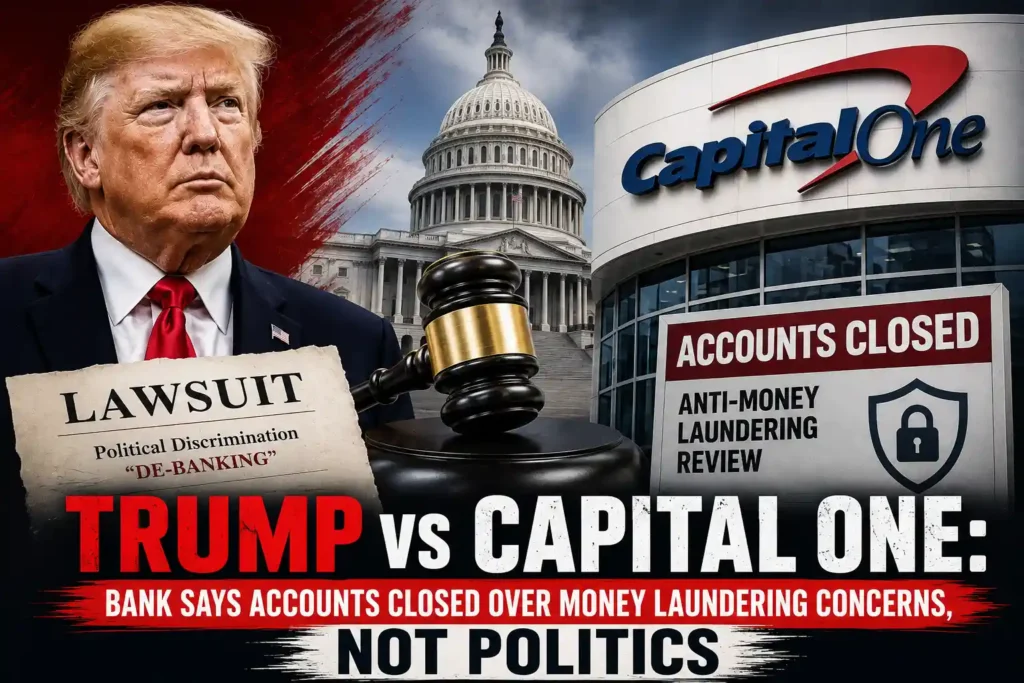
Capital One Financial Corporation told a federal court in Florida on 1 August 2026 that it closed more than 300 bank accounts belonging to the Trump Organization in 2021 because of concerns raised during an internal anti-money laundering review, not because of political discrimination as alleged in an ongoing lawsuit filed by President Donald Trump’s real estate company. The filing marks the first time the bank has formally linked its compliance process to the account closures, in a case that has already been dismissed twice by the presiding judge, with the Trump Organization each time given the opportunity to file an amended complaint.
The dispute dates back to the aftermath of the 6 January 2021 riot at the US Capitol, when several major financial institutions began reviewing or ending relationships with businesses linked to Mr Trump. The Trump Organization and Eric Trump, an executive vice president at the company, argue the closures amounted to unlawful “de-banking” driven by political motives. Capital One denies this and says the decision followed standard regulatory compliance procedures.
Quick Overview
| Question | Short Answer |
|---|---|
| What happened? | Capital One told a court it closed Trump Organization accounts after an internal anti-money laundering review, not for political reasons. |
| Why is Trump suing Capital One? | The Trump Organization alleges the bank closed its accounts in 2021 due to political bias following the Capitol riot. |
| What does Capital One say? | The bank says the closures followed a compliance review by its anti-money laundering team and were unrelated to politics. |
| What is the lawsuit about? | A claim of political discrimination and unlawful account termination, known as “de-banking.” |
| Current status | The case has been dismissed twice, with amended complaints filed each time; Capital One’s latest filing seeks dismissal again. |
| Next expected step | The presiding judge is expected to rule on Capital One’s request to dismiss the amended complaint. |
What Happened?
In a court filing submitted late on Friday, 1 August 2026, Capital One argued that the Trump Organization’s amended complaint should be dismissed because it fails to show evidence of political discrimination. According to the filing, the bank stated that documents already shared with the plaintiffs, along with their own allegations, indicate the accounts were closed for anti-money laundering reasons.
The filing is notable because it is the first instance in the case where Capital One has directly tied its 2021 decision to a specific internal compliance process, rather than issuing a general denial of wrongdoing. The bank has not accused the Trump Organization of actual money laundering; rather, it says its compliance team flagged transaction patterns that fall under categories identified in federal banking guidance, prompting the account closures as a precautionary and regulatory measure.
This matters because it shifts the legal question away from a broad dispute over political motive and toward a narrower one: whether the Trump Organization can produce evidence contradicting the bank’s stated compliance rationale.
Background of the Case
The origins of the dispute go back several years:
- 2021: Capital One notified the Trump Organization in March that it planned to close more than 300 accounts linked to the company. The closures were finalised around June 2021, in the months following the Capitol riot.
- 2025: The Trump Organization and Eric Trump filed a lawsuit in a Florida federal court in March 2025, seeking a declaratory judgment that the closures were improper, along with monetary and punitive damages.
- Mid-2025: A judge paused the discovery process — the exchange of evidence between both sides — while considering whether the case was likely to be dismissed.
- March 2026: US District Judge Roy Altman in Miami dismissed the complaint, ruling it was “deficient,” but allowed the Trump Organization the chance to refile with additional evidence.
- July 2026: An amended complaint was filed, including a section describing the alleged “political trigger” behind the closures, though a significant portion of that section remains redacted in public filings.
- August 2026: Capital One filed its response, asking the court to dismiss the amended complaint and formally citing its anti-money laundering review for the first time.
This sequence shows a case that has moved slowly through procedural stages, with the core factual dispute — why the accounts were really closed — still unresolved.
Why Capital One Closed the Accounts
According to Capital One’s court filings, the bank’s position rests on a compliance-driven explanation:
- The bank says its anti-money laundering (AML) specialists conducted a months-long internal review of the Trump Organization’s accounts.
- More than 300 accounts affiliated with the company were included in this review.
- Capital One states that transaction patterns identified during the review matched categories of activity flagged under federal banking guidance.
- The bank gave formal notice of its intention to close the accounts in March 2021, ahead of the closures being completed later that year.
- Capital One has explicitly said it is not accusing the Trump Organization of illegal money laundering — only that its internal review identified reasons consistent with standard AML compliance obligations.
It is important to note that these are the bank’s own stated reasons, presented as part of its legal defence. No court has yet ruled on whether this explanation is accurate or complete, and the claims should not be read as an established finding of fact.
Trump Organization’s Position
The Trump Organization and Eric Trump have consistently rejected Capital One’s compliance-based explanation. Their position, as set out in court filings and public statements, includes the following points:
- The lawsuit alleges the account closures were driven by political discrimination, timed closely to the aftermath of the 6 January 2021 Capitol riot.
- Eric Trump has previously described the closures as an attack on free speech and free enterprise, saying they forced the company to seek new banking relationships at significant cost.
- The amended complaint filed in July 2026 includes a section titled “January 6, 2021: The Political Trigger,” which is almost entirely redacted in the public court record, leaving the specific evidence behind this claim unclear for now.
- The Trump Organization argues that Capital One’s compliance explanation is a retroactive justification rather than the true motive behind the 2021 decision.
As with Capital One’s position, these remain allegations that have not been independently verified by the court. The case’s outcome will depend on what evidence, if any, can be presented to support either side’s account.
Case History
The litigation has already passed through several rounds of dismissal and amendment:
- The Trump Organization’s original complaint was dismissed by Judge Altman in March 2026, who found it lacked sufficient factual support, while granting leave to amend.
- A second version of the complaint was also found wanting by the court, with Capital One arguing it “suffers from the same fundamental flaws” as the earlier filings.
- A further amended complaint was filed in July 2026, introducing the partially redacted section referencing the Capitol riot as an alleged trigger for the closures.
- Capital One’s August 2026 filing responds to this latest version, again seeking dismissal and, for the first time, detailing the anti-money laundering rationale in court documents.
This pattern — dismissal, amendment, renewed dismissal request — is common in complex civil litigation where a plaintiff must meet a specific evidentiary threshold to proceed past the pleading stage.
Legal Issues Explained
For readers unfamiliar with the legal and banking terms involved, here is a simplified explanation:
Anti-money laundering (AML) reviews: Banks are legally required to monitor customer accounts for transaction patterns that could indicate financial crime, even if no wrongdoing is ultimately found. This is a standard, ongoing compliance obligation, not an accusation.
Bank compliance obligations: Financial institutions must follow federal guidance on flagging and, where necessary, closing accounts linked to certain risk indicators. This process is separate from any judgment about a customer’s character or business legitimacy.
Why banks sometimes close accounts: Institutions may end a banking relationship for reasons including regulatory risk, reputational risk, or internal policy — not necessarily because of any proven misconduct by the account holder.
Compliance decisions versus political discrimination claims: The key legal question in this case is whether Capital One’s stated compliance reasons are genuine, or whether they mask an underlying political motive, as the Trump Organization alleges. Establishing discrimination generally requires more than circumstantial timing; it typically requires direct or strong indirect evidence of intent.
What Happens Next?
Following Capital One’s latest filing, the court is expected to consider whether the amended complaint adequately alleges facts supporting political discrimination, or whether it should again be dismissed. Several outcomes are possible:
- The judge could dismiss the case for a third time, potentially with or without further opportunity to amend.
- The judge could allow the case to proceed to discovery, requiring both sides to exchange evidence.
- Settlement remains a possibility at any stage, though neither party has indicated this is currently under discussion.
No specific ruling date has been confirmed publicly, and it would not be accurate to predict the court’s decision. Readers should treat any timeline estimates as general procedural expectations rather than confirmed outcomes.
Why This Case Matters
The case has significance beyond the two parties directly involved:
- Banking compliance: It highlights how anti-money laundering obligations can lead to account closures that are later challenged in court, raising questions about transparency in the closure process.
- Business account closures: The case is being watched by other businesses and account holders who have experienced so-called “de-banking,” a term used to describe the termination of banking relationships perceived as politically or ideologically motivated.
- Regulatory context: The case intersects with broader government scrutiny of banks, including a “fair banking” executive order aimed at examining alleged political or religious discrimination in financial services, to which several major banks, including Capital One, have said they are responding.
- Legal precedent: Depending on the outcome, the case could influence how courts evaluate similar claims where a company alleges political motive behind a bank’s compliance-based account closure.
Frequently Asked Questions
Why did Capital One close Trump’s accounts? Capital One says the closures followed an internal anti-money laundering review that flagged certain transaction patterns, not political considerations.
What is the Trump Capital One lawsuit about? The Trump Organization alleges Capital One unlawfully closed more than 300 of its accounts in 2021 due to political discrimination following the Capitol riot.
Did Capital One accuse Trump of money laundering? No. Capital One has stated it is not accusing the Trump Organization of illegal money laundering, only that its internal review identified activity consistent with standard compliance flags.
What does the latest court filing say? The filing, submitted 1 August 2026, argues the amended complaint should be dismissed and formally cites the bank’s anti-money laundering review as the reason for the account closures.
When was the lawsuit filed? The Trump Organization and Eric Trump filed the lawsuit in March 2025 in a Florida federal court.
Has the case been dismissed before? Yes. The case has been dismissed twice by the presiding judge, with the plaintiffs given the opportunity to amend their complaint each time.
What happens next? The court will consider Capital One’s request to dismiss the latest amended complaint. No ruling date has been publicly confirmed.
Could the judge dismiss the case again? It is possible, but this cannot be predicted with certainty. The outcome depends on whether the amended complaint meets the legal threshold required to proceed.
Is this related to other bank account closure disputes? Yes, this case is part of a wider discussion around “de-banking” and government scrutiny of financial institutions’ account closure practices, discussed further in our banking regulation explainer.
Where can I read more about the broader context of this dispute? You can find more background in our related coverage on Trump Organization legal disputes and how US banks handle compliance reviews.
Final Thoughts
The Trump Organization’s case against Capital One remains at an early legal stage, with both sides presenting sharply different explanations for the 2021 account closures. Capital One’s latest filing formally attributes the decision to an anti-money laundering review, while the Trump Organization continues to maintain the closures were politically motivated. Neither explanation has been confirmed by the court, and the matter is expected to proceed through further procedural stages before any substantive ruling on the merits. Readers following related developments can also refer to our coverage of de-banking controversies in the US, Capital One’s ongoing legal matters, and Eric Trump’s role at the Trump Organization.
Author Reviewed
This article was reviewed for factual accuracy and neutrality prior to publication.
Last Updated
2 August 2026
Editorial Standards
This report follows fact-based, neutral reporting standards, attributing all claims to court filings, company statements, and named sources. Allegations are clearly distinguished from established facts throughout.
Sources
- Court filings, Donald J. Trump Revocable Trust et al v. Capital One, N.A.
- Bloomberg News
- CNBC
- Yahoo Finance / Investing.com (via Reuters)
- NBC News
Disclaimer
This article is for informational purposes only and does not constitute legal advice. It summarises publicly available court filings and news reports and does not represent a legal conclusion regarding the merits of the case.